
STAINLESS INDIA is a leading Stockist & Supplier of all Ferrous & Non-Ferrous Metals.
Contact
+91 97680 42420Location
Office No. 301, 3rd Floor, Praman Heritage, Vitthal Bhai Patel Road, Sikkanagar, Girgaon,Mumbai - 400 004, Maharashtra. India
STAINLESS INDIA is a leading Stockist & Supplier of all Ferrous & Non-Ferrous Metals.
Contact
+91 97680 42420Location
Office No. 301, 3rd Floor, Praman Heritage, Vitthal Bhai Patel Road, Sikkanagar, Girgaon,Mumbai - 400 004, Maharashtra. India

API 5L X65 carbon steel line pipe supplier in India offering seamless, welded, PSL1 and PSL2 pipes with specifications, sizes, schedules, testing, coatings and certifications.
 />
/>
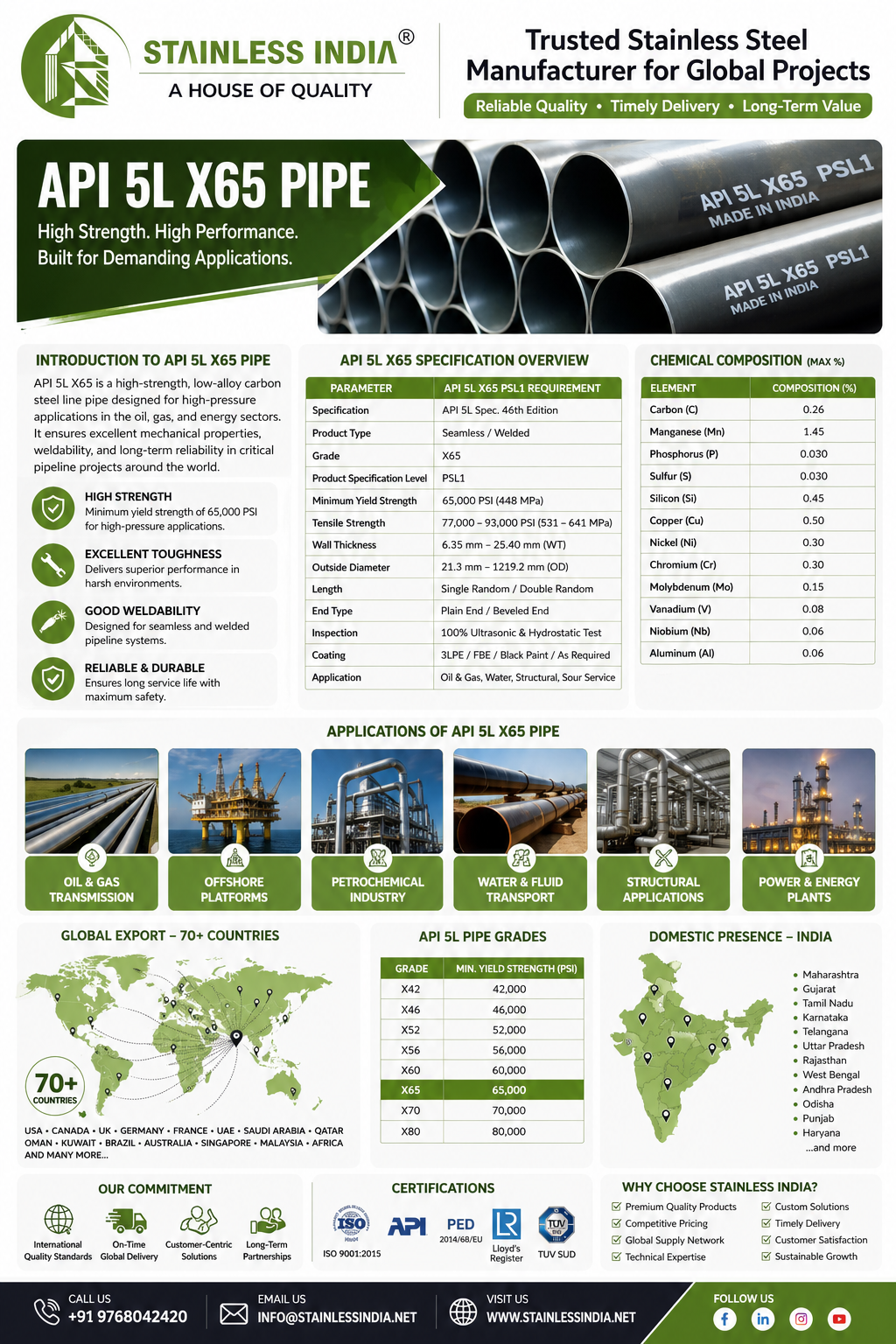
The API 5L X65 standard is an essential benchmark for oil and gas pipelines, coding the high-pressure required strength and covering both seamless steel tubes and welded steel tubes. API 5L Grade X65 comprises high-strength, low-almost carbon steel tubes with tight mechanical requirements, adapted to the service of X65 PSL1. The X65 label itself indicates a defined minimum performance of 65,000 psi, a label that is suitable for the most demanding pipeline companies. With this API 5L level, the pipes can support significant internal and external pressures, thereby determining the safety and sustainability of infrastructure projects. For engineers and procurement professionals, strict compliance with API 5L X65 is essential to ensure robust, reliable line pipe solutions.
Because of its exceptional strength, ductility, and affordability, carbon steel is essential to the production of line pipe. The exact chemical makeup of carbon steel is meticulously regulated for API 5L X65 pipe in order to attain the required mechanical characteristics, such as strong yield strength and tensile strength, without sacrificing weldability. When using API 5L X65 PSL1 seamless alternatives, carbon steel pipe's inherent durability makes it perfect for moving oil, natural gas, and other fluids over long distances, frequently in harsh climatic conditions. Its status as a favoured material for vital pipeline infrastructure is further cemented by its ease of forming and welding into a variety of pipe sizes and wall thickness possibilities.
API 5L X65 pipe is widely used in a variety of high-pressure and critical settings where exceptional strength and dependability are essential. Long-distance oil and gas transmission lines, notably those that need sour service capabilities and where resistance to hydrogen sulphide stress corrosion cracking is essential, are the main applications for this type of steel pipe. Additionally, API 5L Grade X65 pipe is used in risers, offshore platforms, and other structural elements that require a strong wall thickness and high yield strength to withstand challenging operating circumstances. It is a key component of energy infrastructure worldwide due to its adaptability to both onshore and offshore projects, especially when it comes to grade pipe standards.
When thinking about API 5L X65 line pipe for critical applications, the difference between seamless and welded pipe is crucial. Both are utilized, but their production methods and end products are very different.
| Pipe Type classifications encompass a range of grades, including API 5L X65 and API 5L Gr X42. | A key manufacturing characteristic of API 5L X65 is its capacity to be manufactured as a seamless steel pipe. | Overall Benefit |
|---|---|---|
| Seamless Pipe | Crafted from a solid round steel billet. | Provides improved resistance to stress and fatigue because it lacks a weld seam. |
| Welded Pipe | Manufactured from steel sheets shaped into a cylindrical form and joined together through a longitudinal weld. |
Seamless pipe typically provides improved resistance to stress and fatigue, especially in sour service conditions, because it lacks a weld seam that might serve as a weak point under high pressures. This type of pipe is particularly sought after for high-pressure and high-temperature applications, notably within the API 5L pipe category.
The API 5L specification divides line pipe into two product specification levels: PSL1 and PSL2, each having specific requirements for API 5L X65 pipe.
| Product Specification Level | Characteristics for API 5L X65 Pipe |
|---|---|
| API 5L X65 PSL1 | Denotes a standard grade characterized by fundamental mechanical properties and testing criteria, which encompass those required for grade X42. |
| API 5L X65 PSL2 | Complies with stricter standards for chemical composition, mechanical properties, and non-destructive testing requirements, particularly for API 5L Grade X65 PSL1. It generally necessitates elevated toughness values, limits carbon equivalent, and frequently demands supplementary impact testing, rendering it suitable for sour service applications and other essential environments, especially regarding API 5L Grade X65 PSL1. This improved specification guarantees a greater degree of reliability and safety, which is crucial for significant pipeline infrastructure initiatives. |
The key feature of API 5L X65 pipe is its remarkably high yield strength, indicated by the "X65" label, which represents a minimum yield strength of 65,000 psi (450 MPa). This increased yield strength facilitates the design of pipelines with thinner walls, resulting in lower material costs and reduced weight while maintaining overall structural integrity and pressure containment capabilities. Additionally, the high yield of API 5L X65 steel pipe enhances its notable tensile strength, allowing it to endure substantial operational stresses and external forces. This blend of high yield and tensile strength, along with a carefully controlled chemical composition, guarantees that API 5L Grade X65 pipe can reliably perform in challenging applications such as long-distance oil and gas transmission, where resistance to deformation and failure under extreme pressure is essential.
Choosing the appropriate supplier for API 5L Grade X65 pipe is a crucial choice that significantly affects the integrity and durability of pipeline projects. A dependable supplier should exhibit a deep comprehension of the API 5L specification, including the specific details of API 5L X65 PSL1 and API 5L X65 PSL2 requirements. Important factors to consider include the supplier's ability to deliver both seamless pipe and, where necessary, X65 welded pipe, ensuring a full range of pipe sizes and specified wall thickness options. Additionally, the supplier must provide strong technical support, aiding in compliance with the precise mechanical properties and chemical composition required by the project, particularly for high yield and sour service applications. It is vital to verify their history and compliance with quality standards to ensure a successful procurement process.
India boasts a strong network of manufacturers and suppliers that specialize in carbon steel pipes, including essential grades such as API 5L X65.These suppliers are gaining global recognition for their capability to produce high-quality API 5L X65 seamless and welded pipes, adhering to strict international standards to guarantee durability and mechanical strength. Numerous Indian suppliers hold ISO certification for API 5L Grade, reflecting their dedication to quality management systems. When looking for API 5L Grade X65 pipe suppliers in India, it is important to seek those with a substantial inventory of API 5L X65 line pipes, which includes a variety of pipe sizes, wall thicknesses, and schedules, such as schedule 40 X65 welded pipe stock. Reputable suppliers typically have experience with sour service pipes and offer thorough documentation for their carbon steel seamless pipes and other products, ensuring they meet the required minimum tensile and yield strength.
Assessing the quality and certification of API 5L X65 line pipe is crucial for ensuring both project safety and operational reliability.Certification to API 5L grade standards, particularly for API 5L X65, verifies that the steel pipe fulfills the necessary mechanical properties, chemical composition, and manufacturing tolerances. It is vital to confirm that the supplier delivers quality API 5L products, including X65 PSL1 pipe, along with certified API 5L Grade X65 pipe, which should be supported by detailed mill test reports. The specifications that outline the actual yield strength, tensile strength, and impact toughness of API 5L Gr X65 are essential for quality assurance. For sour service pipe, it is imperative to have additional certifications and testing protocols in place to ensure resistance to stress corrosion cracking. Moreover, compliance with product specification levels (PSL1 and PSL2) must be rigorously verified, particularly for API 5L X65 PSL2, which imposes more stringent requirements for critical applications, thus ensuring the integrity of the steel line pipe.
The availability of API 5L X65 pipe in a variety of sizes and schedule charts is essential for meeting the diverse needs of projects in the oil and gas sector. This high-yield carbon steel pipe is produced to exact specifications, with outer diameters generally ranging from 2 inches to more than 48 inches, along with a variety of wall thickness options. The schedule chart for API 5L X65 pipe outlines the wall thickness corresponding to a specific nominal pipe size, ensuring that the steel pipe can endure the designated internal pressure and external loads while preserving its mechanical properties. Grasping these dimensions is vital for engineers to accurately design pipeline systems, guaranteeing optimal flow characteristics and structural integrity, particularly when taking into account the strong tensile and yield strength that are characteristic of the API 5L Grade X65 specification.
Distinguishing Grade X65 from other API 5L grades is crucial for choosing the right steel pipe for particular applications. The "X" in API 5L X65 indicates its minimum yield strength of 65,000 psi, categorizing it as a high-strength low-alloy carbon steel pipe, unlike API 5L Grade B and API 5L Gr X42.
| API 5L Grade | Minimum Yield Strength | Common considerations for the application of API 5L X65 involve its deployment in diverse environments, highlighting the importance of adhering to quality API 5L standards, especially for the X65 grade PSL1 line pipe. |
|---|---|---|
| API 5L X52 | 52,000 psi | When choosing between schedule 40 and schedule 160 for API 5L line pipe, it is crucial to consider less demanding conditions and economic factors, especially in relation to wall thickness tolerance. |
| API 5L X56 | A pressure of 56,000 psi is an essential benchmark for the mechanical strength needed in grade X65 line pipe applications. | Less demanding conditions, economic considerations |
| API 5L X60 | 60,000 psi | (Not specified in original text) |
| API 5L X65 | 65,000 psi | High-strength low-alloy carbon steel applications |
| API 5L X70 is another specification that complements the mechanical strength of API 5L X65 PSL1 line pipe. | 70,000 psi | Very high-pressure applications, enabling thinner walls and larger sizes for the pipe body using API 5L X65. |
Selecting the appropriate API 5L grade requires a careful consideration of operational pressure, fluid properties, environmental conditions, and cost efficiency, while also ensuring that the necessary mechanical properties and safety margins for the steel line pipe are satisfied.
A thorough grasp of API 5L specifications is crucial for choosing the right grade of pipe for applications. Essential fittings for API 5L line pipe, including those suitable for API 5L X65 and X60 pipes, are important for building complete pipeline systems. These fittings, made from compatible carbon steel and tailored to fit the specific wall thickness and pipe sizes of the API 5L X65 pipe, consist of elbows for directional shifts, tees for branching, reducers for diameter adjustments, and flanges for connecting to valves and other equipment. The choice of fittings must correspond with the mechanical properties and chemical makeup of the API 5L Grade X65 pipe, ensuring the overall system's integrity, particularly in high-pressure or sour service conditions. Compliance with strict specifications for these fittings ensures they possess the same high yield strength and tensile strength as the main line pipe, thereby avoiding potential failure points.
Sour service pipe denotes carbon steel piping, such as API 5L X65, that is specifically designed to function effectively in environments where hydrogen sulfide (H2S) is present, a gas known for its corrosive and toxic properties. The existence of H2S can result in various types of corrosion and cracking, particularly sulfide stress cracking (SSC) and hydrogen-induced cracking (HIC), which can significantly undermine the structural integrity of the steel pipe. To address these challenges, sour service pipes, including API 5L X65 PSL2, are produced with a meticulously controlled chemical makeup, often featuring lower carbon equivalent values and stringent restrictions on sulfur and phosphorus levels. These precautions improve the pipe's resistance to degradation caused by H2S, thereby ensuring the safe and uninterrupted transport of sour gas and oil, as outlined in the specifications for 5L Grade X65 pipe.
In sour service applications, the significance of exceptional corrosion resistance for API 5L X65 line pipe, particularly in contexts like L450 pipe, is crucial. The corrosive properties of hydrogen sulfide require that the steel pipe demonstrates outstanding durability against various types of deterioration, including pitting, general corrosion, and the more severe sulfide stress cracking. For API 5L X65 PSL2 pipe utilized in sour service, manufacturers apply specific metallurgical controls, such as a fine-grained microstructure and regulated rolling processes, to improve its resistance. This emphasis on corrosion resistance is vital for averting catastrophic failures, prolonging the operational life of the pipeline, and protecting both personnel and the environment, thus making it an essential consideration in the selection and specification of API 5L Grade X65 pipe.
API 5L X65 pipe is often chosen for sour service applications because of its high yield strength and the capability of manufacturers to customize its chemical composition and mechanical properties to withstand H2S environments. When specified for sour service, API 5L X65 pipe generally adheres to PSL2 pipe standards, which require stricter regulations on carbon equivalent and sulfur content, and frequently involve additional testing for hydrogen-induced cracking (HIC) and sulfide stress cracking (SSC).This strong performance makes API 5L Grade X65 pipe a favored option for the transportation of sour natural gas and oil under difficult conditions. Reputable suppliers, such as X65 pipe suppliers in India, guarantee that their sour service pipes comply with these rigorous specifications, offering certified API 5L Grade X65 material that provides both strength and corrosion resistance for essential energy infrastructure.
The API 5L X65 pipe is a robust carbon steel line pipe manufactured according to the American Petroleum Institute (API) specification 5L, and it is specifically categorized as a PSL 2 pipe. This type of pipe is frequently utilized in pipelines for the transportation of oil, natural gas, and water, owing to its excellent mechanical properties and weldability, especially in applications involving X60 pipe.
The phrase "API 5L X65 pipe" refers to pipes made from X65 grade steel in accordance with API Spec 5L. The designation X65 signifies a minimum yield strength of 65,000 psi (around 450 MPa) for specific wall thicknesses and diameters. API 5L encompasses both seamless and welded (ERW, LSAW, SSAW, HFW) steel pipes intended for pipeline transportation systems within the petroleum and natural gas sectors.
Typical composition for API 5L X65 pipe (values are approximate and subject to mill certificates):
To safeguard against corrosion and enhance service longevity, API 5L X65 pipes are typically provided with:
API 5L X65 pipes meet the specifications outlined in API Spec 5L. Customers frequently request extra certifications and compliance with standards such as ISO, EN, or those specific to their projects. Pipes can be provided according to PSL1 (standard) or PSL2 (which includes additional requirements such as more stringent testing and traceability).
For quotes, technical datasheets, mill test certificates, and supply lead times regarding API 5L X65 carbon steel line pipe, please reach out to your supplier or manufacturer with the detailed specifications provided above.Ensuring proper selection, testing, and coating is essential for maintaining long-term pipeline integrity in oil, gas, and water transmission systems.
We provide API 5L X65 pipe through various manufacturing processes and specifications to cater to pipeline, oil & gas, and industrial applications. The available types consist of seamless, ERW, welded, LSAW, HSAW, DSAW, and SSAW.
All API 5L X65 pipe products meet the material and manufacturing standards set by API 5L.We offer both PSL-1 and PSL-2 certified materials, complete with Mill Test Certificates (MTC), Positive Material Identification (PMI), Ultrasonic Testing (UT), Radiographic Testing (RT), hydrostatic test reports, and third-party inspection upon request.
API 5L X65 line pipe is utilized in high-strength pipeline systems that include:
For inquiries regarding quotations, technical data sheets, and the availability of API 5L X65 pipe, please reach out to our sales team. Be sure to specify the grade (X65 PSL1 or X65 PSL2), the type of pipe (seamless, ERW, LSAW, HSAW, DSAW, SSAW), as well as the size and quantity to receive a prompt response.
© STAINLESS INDIA Supplier — API 5L X65 Pipe
We provide API 5L X65 pipes that meet PSL-2 specifications, available in various manufacturing types such as seamless, ERW, welded, LSAW, HSAW, DSAW, and SSAW.Our API 5L carbon steel pipes come in grades X42, X46, X52, X56, X60, X65, X70, and X80, with both PSL-1 and PSL-2 certifications.
For quotes, mill test certificates, and delivery timelines regarding API 5L X65 pipe and other API 5L carbon steel pipes, please reach out to us.
We are a prominent manufacturer and exporter of API 5L X65 line forged fittings, focusing on high-quality API 5L X65 carbon steel line forged fittings designed for pipeline and oil & gas applications. Our API 5L X65 pipe fittings comply with rigorous industry standards and provide outstanding mechanical properties, resistance to corrosion, and precise dimensional accuracy.
Reach out to us for competitive pricing and technical assistance regarding API 5L X65 line forged fittings and associated API 5L X65 pipe products. We guarantee prompt delivery, complete documentation, and adherence to international standards for every order.
We are a premier provider of Grade X65 high yield pipe and API 5L X65 PSL2 pipe materials in India, ensuring dependable sourcing for oil, gas, and pipeline construction initiatives. Our stock features both seamless and welded API 5L X65 pipe available in a range of diameters, wall thicknesses, and lengths to satisfy project requirements and adhere to industry standards.
| Property | Specification |
|---|---|
| Standard | API Spec 5L |
| Grade | X65 |
| Product Specification Level | PSL1 / PSL2 |
| Pipe Type | Seamless, ERW, LSAW, SSAW |
| Outside Diameter | 1/2" NB to 60" NB |
| Wall Thickness | SCH 10 to SCH XXS |
| Length | Single Random, Double Random, Custom Cut Length |
| Ends | Plain End, Beveled End, Threaded |
| Testing | Hydro Test, UT, RT, PMI, Mechanical Testing |
| Certification | EN 10204 3.1 / Third Party Inspection |
| Property | Specification |
|---|---|
| Standard | API Spec 5L |
| Grade | X65 |
| Product Specification Level | PSL1 / PSL2 |
| Pipe Type | Seamless, ERW, LSAW, SSAW |
| Outside Diameter | 1/2" NB to 60" NB |
| Wall Thickness | SCH 10 to SCH XXS |
| Length | Single Random, Double Random, Custom Cut Length |
| Ends | Plain End, Beveled End, Threaded |
| Testing | Hydro Test, UT, RT, PMI, Mechanical Testing |
| Certification | EN 10204 3.1 / Third Party Inspection |
| Element | Maximum (%) |
|---|---|
| Carbon (C) | 0.28 |
| Manganese (Mn) | 1.40 |
| Phosphorus (P) | 0.030 |
| Sulfur (S) | 0.030 |
| Silicon (Si) | 0.45 |
| Niobium + Vanadium + Titanium | As per API 5L Specification |
Note: The exact chemical composition may vary depending on whether the pipe is manufactured to PSL1 or PSL2 requirements and according to the approved mill manufacturing process.
| Property | Requirement |
|---|---|
| Minimum Yield Strength | 450 MPa (65,300 psi) |
| Minimum Tensile Strength | 535 MPa (77,500 psi) |
| Elongation | As per API Spec 5L formula |
| Impact Test | Required for PSL2 (when specified) |
| Hydrostatic Test | As per API Spec 5L requirements |
Note: Mechanical property requirements depend on the applicable API Spec 5L edition, pipe size, wall thickness and whether PSL1 or PSL2 is specified.
| Parameter | Available Range |
|---|---|
| Nominal Pipe Size (NPS) | 1/2" NB to 60" NB |
| Outside Diameter (OD) | 21.3 mm to 1524 mm |
| Wall Thickness | SCH 10, 20, 30, 40, STD, 60, 80, XS, 100, 120, 140, 160 & XXS |
| Pipe Length | Single Random, Double Random & Custom Length |
| End Finish | Plain End (PE), Bevel End (BE), Threaded End |
| Manufacturing Types | Seamless, ERW, LSAW & SSAW |
Custom sizes and wall thicknesses can be supplied based on project specifications, subject to mill availability.
API 5L X65 pipes are manufactured using advanced production processes to meet the requirements of API Spec 5L for pipeline transportation systems. The manufacturing method is selected based on pipe diameter, wall thickness, service conditions and project specifications.
| Manufacturing Type | Description | Typical Applications |
|---|---|---|
| Seamless (SMLS) | Produced from solid billets using hot piercing and rolling. | High-pressure pipelines and critical services. |
| ERW | Electric Resistance Welded using high-frequency welding. | Oil, gas, water transmission and structural applications. |
| LSAW | Longitudinal Submerged Arc Welded from steel plates. | Large diameter pipelines and offshore projects. |
| SSAW | Spiral Submerged Arc Welded for large-diameter pipe production. | Water transmission, piling and long-distance pipelines. |
Each pipe undergoes quality control procedures to verify dimensional accuracy, weld integrity (where applicable), mechanical properties and compliance with API Spec 5L requirements before dispatch.
Every API 5L X65 pipe supplied by Stainless India undergoes rigorous inspection and testing to ensure compliance with API Spec 5L and customer project requirements. Inspection may be witnessed by third-party inspection agencies when specified.
| Inspection / Test | Purpose |
|---|---|
| Visual Inspection | Checks surface quality, finish and workmanship. |
| Dimensional Inspection | Verifies OD, wall thickness, length and straightness. |
| Hydrostatic Test | Confirms pressure integrity of the pipe. |
| Ultrasonic Testing (UT) | Detects internal discontinuities and defects. |
| Radiographic Testing (RT) | Examines weld quality for welded pipes where applicable. |
| Mechanical Testing | Verifies tensile strength, yield strength and elongation. |
| Chemical Analysis | Confirms compliance with API Spec 5L chemistry requirements. |
| Positive Material Identification (PMI) | Available on request to verify material grade. |
Material Test Certificates (EN 10204 3.1) and third-party inspection reports can be supplied when required by the project specification.
| Feature | Available Options |
|---|---|
| External Coatings | Black Paint, Varnish, 3LPE, 3LPP, FBE, Coal Tar Epoxy (subject to project requirements) |
| Internal Coatings | Epoxy Lining, Cement Mortar Lining or as specified by the customer |
| End Finish | Plain End (PE), Bevel End (BE), Threaded End |
| Pipe Marking | Manufacturer, Grade, Size, Heat Number, API Spec, Schedule, Batch Number |
| Packaging | Bundled, Loose, Wooden Boxes, End Caps and Export-Seaworthy Packing |
Coating systems, end preparation and packaging can be customized according to project specifications, transportation requirements and destination country standards.
API 5L X65 pipes are designed for demanding pipeline systems where high strength, durability and reliable performance are essential. They are widely used in energy, infrastructure and industrial projects across the world.
| Industry | Typical Applications |
|---|---|
| Oil & Gas | Crude oil transmission, natural gas pipelines, gathering systems |
| Petrochemical | Process piping and refinery projects |
| Power Generation | Cooling water systems and utility pipelines |
| Water Infrastructure | Municipal water transmission and distribution |
| Offshore & Marine | Platform piping, subsea support systems and coastal projects |
| Construction | Industrial plants, structural applications and EPC projects |
| Mining | Slurry transport and mineral processing pipelines |
Stainless India supplies API 5L X65 pipes for domestic and international projects with complete documentation, quality assurance and export-ready packaging.
Selecting the correct API 5L grade depends on the required operating pressure, mechanical strength and project specifications. The comparison below provides a general overview of three commonly used API 5L grades.
| Property | API 5L X52 | API 5L X65 | API 5L X70 |
|---|---|---|---|
| Minimum Yield Strength | 52,000 psi (359 MPa) | 65,000 psi (450 MPa) | 70,000 psi (483 MPa) |
| Typical Applications | General pipelines | High-pressure transmission pipelines | Long-distance, high-pressure transmission |
| Pressure Capability | Medium | High | Very High |
| Cost | Lower | Medium | Higher |
| Availability | Excellent | Excellent | Project Specific |
The final grade selection should always be based on the applicable design code, operating conditions, project specifications and engineering calculations.
Stainless India supplies API 5L X65 pipes with export-quality packaging and complete documentation to ensure safe transportation and compliance with international project requirements.
| Category | Details |
|---|---|
| Packaging | Bundles, loose pipes, wooden boxes, end caps and seaworthy export packing. |
| Marking | Grade, size, heat number, schedule, API specification, manufacturer identification and customer marking (if required). |
| Standard Documents | Commercial Invoice, Packing List, Certificate of Origin and Mill Test Certificate (EN 10204 3.1). |
| Optional Documents | Third-Party Inspection (TPI), NACE compliance (when specified), NABL laboratory reports and customer-specific documentation. |
| Export Markets | Middle East, Europe, Africa, Asia-Pacific, North America and other international destinations. |
Documentation can be customized to meet project specifications, EPC contractor requirements and international shipping regulations.
| API 5L X65 Pipe |
| API 5L Grade X65 Pipe |
| API 5L X65 PSL2 Pipe |
| API 5L X65 PSL1 Pipe |
| API 5L X65 Seamless Pipe |
| API 5L X65 Welded Pipe |
| API 5L X65 ERW Pipe |
| API 5L X65 DSAW Pipe |
| API 5L X65 LSAW Pipe |
| API 5L X65 SAW Pipe |
| X65 Carbon Steel Pipe |
| ISO 3183 L450 Pipe |
| API 5L X65 Sour Service Pipe |
| API 5L X65 NACE Pipe |
| API 5L X65 Pipe Supplier |
| X65 Pipe Supplier In India |
| API 5L X65 Pipe Manufacturers |
| API 5L X65 Pipe Weight Chart |
| API 5L X65 Pipe Dimensions |
| API 5L X65 Pipe Mechanical Properties |
| API 5L X65 Pipeline |
| API 5L Seamless Steel Line Pipe |
We are a premier provider of Grade X65 high yield pipe and API 5L X65 PSL2 pipe materials in India, ensuring dependable sourcing for oil, gas, and pipeline construction initiatives.Our stock features both seamless and welded API 5L X65 pipe available in a range of diameters, wall thicknesses, and lengths to satisfy project requirements and adhere to industry standards.
Grade X65 high yield pipe and API 5L X65 PSL2 are widely used for:
We operate strategic stockyards and logistics partnerships throughout India to guarantee the prompt delivery of API 5L X65 pipe. Our capabilities encompass cutting, beveling, heat treatment, coordination of third-party inspections, and packaging for export.
For inquiries or to obtain a quote for API 5L X65 pipe, please reach out to our sales team with details such as size, schedule/API grade, quantity, and delivery location. We provide certified Grade X65 high yield pipe and API 5L X65 PSL2 material throughout India and for international projects.
API 5L Grade X65 is a robust line pipe grade designed for the transmission of oil, gas, and water. The API 5L specification categorizes material requirements into two levels: Product Specification Level 1 (PSL1) and Product Specification Level 2 (PSL2). Furthermore, pipes that are meant for sour service, which includes environments containing H2S, are required to adhere to additional metallurgical and testing standards to prevent sulfide stress cracking (SSC) and other failures related to hydrogen.
PSL2 signifies a superior quality and more rigorously regulated product compared to PSL1 for API 5L Grade X65, incorporating mandatory toughness, enhanced NDT, and traceability measures. In the case of sour service, irrespective of the PSL level, it is crucial to implement additional metallurgical controls, establish hardness limits, and adhere to NACE/ISO testing requirements to avert hydrogen-related failures; PSL2 is frequently utilized as the foundation for sour-service qualifications.
API 5L X65 is a classification within the API 5L specification for line pipes utilized in the transportation of gas, water, and oil. The X65 designation signifies a minimum yield strength of 65,000 psi. Pipes produced according to API 5L X65 are available through various manufacturing methods (such as ERW, seamless, UOE/LR, etc.), end finishes (including beveled, plain, and threaded), and are manufactured to comply with either PSL1 or PSL2 quality standards based on the intended application and any supplementary testing requirements.
API 5L pipes are defined by their nominal pipe size (NPS) or diameter nominal (DN). The standard range for line pipes includes sizes from small to large diameters, typically starting at NPS 1/2 (DN15) and extending up to NPS 48 (DN1200) and even larger for specialized projects. The key dimensional parameters are:
The wall thickness of API 5L pipe is typically chosen based on pipe schedules (such as Sch 40, Sch 80) or specific designations from mills (STD, XS, XXS). In pipeline applications, the wall thickness is influenced by factors such as design pressure, corrosion allowance, and mechanical specifications. For precise schedule thicknesses, reference standards include ASME B36.10M and ASME B36.19M, particularly for stainless steel pipes.
Typical guidance:
Always refer to the project design calculations or the relevant engineering code (ASME, API) to determine the appropriate schedule for API 5L X65 pipe.
The weight of a pipe is typically represented as weight per unit length (for example, lb/ft or kg/m) and is influenced by the outer diameter (OD) and wall thickness. The approximate calculated weight is given by the formula: π × (OD × wall thickness) × density factor. Exact weights for each nominal pipe size (NPS) and schedule are provided by manufacturers and standards tables. Common factors to consider when choosing pipe weight:
API 5L line pipe can be provided with threaded ends upon request.Common types of threads utilized in piping consist of:
Thread sizes and tolerances should adhere to the designated thread standard (API, ANSI/ASME, or the manufacturer's coupling specification).For threaded connections that bear pressure in pipelines, utilize only authorized coupling systems and confirm adequate thread engagement, compatibility of sealants/compounds, and verification of pressure ratings.
For precise dimensional tables (outer diameter, schedule wall thicknesses, weights per foot, and nominal thread profiles), please consult the relevant ASME/ANSI/API standards and the manufacturer's datasheets for API 5L X65 pipe.
This page outlines the method for calculating weight and includes a quick reference table for API 5L Grade B pipe, which is helpful for comparisons with other grades like API 5L X65 pipe.We utilize the standard formula for steel pipe weight to determine mass per unit length.
Weight (kg/m) = 0.02466 × (D - t) × t, where D = outside diameter (mm) and t = wall thickness (mm).
To convert: 1 kg/m = 0.671969 lb/ft.
For a pipe with OD = 114.3 mm (4") and wall = 6.02 mm: Weight = 0.02466 × (114.3 - 6.02) × 6.02 = 16.55 kg/m ≈ 11.12 lb/ft.
| Nominal Size | OD (mm) | Wall (mm) | Weight (kg/m) | Weight (lb/ft) |
|---|---|---|---|---|
| 1 1/2" | 48.3 | 3.68 | 4.08 | 2.74 |
| 2" | 60.3 | 3.91 | 5.43 | 3.65 |
| 3" | 88.9 | 4.78 | 9.79 | 6.58 |
| 4" | 114.3 | 6.02 | 16.55 | 11.12 |
| 6" | 168.3 | 7.11 | 28.61 | 19.21 |
| 8" | 219.1 | 8.18 | 44.08 | 29.59 |
| 12" | 323.9 | 9.53 | 73.66 | 49.45 |
Short answer:API 5L X65 is fundamentally comparable to ISO 3183 X65 (the identical X-grade in the ISO pipe standard). It signifies a high-strength line pipe grade with a minimum yield strength of approximately 65,000 psi (≈450 MPa).
Details and equivalents:
Note: For engineering, procurement, or substitution purposes, it is essential to always verify the complete standard text or supplier certificates (including chemical composition, tensile/yield strength, toughness, heat treatment, and NDT requirements) to ensure equivalence.
The pressure rating for an API 5L X65 pipe is not a constant value. It varies based on factors such as the pipe's outside diameter (OD), wall thickness (schedule), material strength, design code, safety and corrosion allowances, as well as the operating temperature. API 5L X65 refers to a grade that has a minimum yield strength of approximately 65 ksi (≈448 MPa). However, the allowable working stress utilized in design will be lower according to the relevant piping code (ASME B31.3, B31.4, B31.8, etc.).
Use Barlow’s formula to estimate internal pressure capacity (theoretical burst pressure):
P = 2·S·t / (D - t)
where P = internal pressure, S = material allowable stress (psi), t = wall thickness (in), D = outside diameter (in). For design/working pressure you must apply the applicable safety/design factor, corrosion allowance and code-specific reductions.
For a 6" NPS pipe (OD = 6.625 in) with Schedule 40 wall thickness t = 0.280 in, using S = 65,000 psi (theoretical material strength):
P_burst = 2·65,000·0.280 / (6.625 − 0.280) ≈ 5,737 psi
If a safety/design factor of 2.0 is applied, an approximate working pressure would be ≈2,869 psi. Note: this example is illustrative only; actual allowable stress S and design factor must be taken from the governing piping code and project requirements.
The pressure rating for an API 5L X65 pipe needs to be determined based on the specific outer diameter (OD), wall thickness, temperature, and applicable code requirements. Utilize Barlow’s formula along with the stress permitted by the code and the necessary safety and corrosion allowances to calculate the allowable working pressure.For ratings specific to a project, consult the relevant piping code (ASME/ANSI/API) and the datasheet provided by the pipe manufacturer.
API 5L pipe material pertains to the carbon steel specification established by the American Petroleum Institute (API) for line pipes utilized in the conveyance of oil, gas, and water. This specification encompasses both seamless and welded steel pipes, outlining requirements for chemical composition, mechanical properties, manufacturing processes, testing protocols, and marking standards. A frequently referenced grade within this specification is the API 5L X65 pipe, which signifies a minimum yield strength of 65,000 psi (X65).
API 5L pipe material pertains to the carbon steel specification established by the American Petroleum Institute (API) for line pipes utilized in the conveyance of oil, gas, and water. This specification encompasses both seamless and welded steel pipes, outlining requirements for chemical composition, mechanical properties, manufacturing processes, testing protocols, and marking standards. A frequently referenced grade within this specification is the API 5L X65 pipe, which signifies a minimum yield strength of 65,000 psi (X65).
API 5L pipes are produced through various manufacturing methods, including hot rolling, welding, and, when necessary, heat treatment. These pipes undergo both nondestructive and destructive testing, which encompasses chemical analysis, tensile testing, hardness assessments, flattening tests, hydrostatic or nondestructive evaluations (such as UT and RT), and notch toughness testing to ensure they meet the required impact performance standards.
The API 5L X65 pipe is extensively utilized in long-distance pipelines for gas and oil transmission, as well as in gathering lines and distribution systems that demand higher pressure and strength. Additionally, it is applicable in both onshore and offshore projects, adhering to specific requirements for coating, corrosion protection, and testing.
Adhering to API 5L necessitates certification and traceability to the standard. Furthermore, additional project standards (such as NACE for sour service) or client specifications may impose extra requirements regarding materials, testing, and corrosion resistance.
In summary, API 5L pipe material is a standardized carbon steel utilized in pipeline systems, while the API 5L X65 pipe grade offers a high-strength solution for challenging transmission applications, merging strong mechanical properties with stringent testing and quality assurance.
The API 5L X65 pipe is a grade of line pipe defined by the American Petroleum Institute, intended for the transportation of oil, gas, and water. Its mechanical characteristics are engineered to ensure high strength, excellent ductility, and dependable performance in challenging pipeline applications.
The requirements for impact toughness (Charpy V-notch) are influenced by the service conditions and ordering details. Numerous pipeline projects necessitate a specified minimum absorbed energy at certain temperatures (for instance, 27 J at 0 °C or other values specific to the project). When selecting X65 pipe for cold environments, it is essential to guarantee the necessary notch toughness at the operating temperature.
The mechanical properties of API 5L X65 pipe are validated according to API 5L and applicable supplementary requirements. Mill test certificates (MTCs) and heat treatment documentation provide evidence of yield strength, tensile strength, elongation, impact energy, and any post-weld heat treatment. It is essential to verify the properties for the specific pipe purchase order and project specifications.
If you are inquiring whether the API 5L X65 pipe will fit, the brief response is: it depends on aligning the precise dimensions and types of connections. API 5L X65 refers to a material-grade classification for line pipe (with a yield strength of 65 ksi) and does not ensure compatibility on its own.
Compare the exact pipe OD and wall thickness to the mating part dimensions.
Confirm end connection type (weld, threaded, flanged) and prepare matching ends.
Check applicable standards (API 5L spec, ASME, ANSI) for tolerances and compatibility.
If in doubt, consult the pipe mill test report (MTR) and a piping engineer or supplier.
In conclusion: The API 5L X65 pipe is compatible if its nominal size, wall thickness, end finish, and tolerances align with the components you are connecting. It is essential to confirm the dimensional specifications and connection details prior to installation.
The API 5L X65 pipe is a robust line pipe utilized for the transmission of oil and gas. By choosing an API 5L X65 pipe schedule, you are defining the wall thickness standard, which influences pressure capacity, mechanical strength, and the pipe's appropriateness for particular operating conditions.
| NPS (in) | OD (in) | SCH 40 (in) | SCH 80 (in) | SCH XS / 160 (in) |
|---|---|---|---|---|
| 2 | 2.375 | 0.154 | 0.218 | 0.279 |
| 4 | 4.500 | 0.237 | 0.337 | 0.436 |
| 8 | 8.625 | 0.322 | 0.500 | 0.688 |
Note: Values above are typical nominal wall thicknesses used for piping schedules. Always verify with the relevant dimension standards (ASME B36.10/B36.19) and project specifications.
API 5L X65 pipe schedules must comply with API 5L chemical, mechanical, and testing requirements. Ensure material test reports (MTRs), heat treatment records, and nondestructive testing (NDT) results are provided per contract and applicable codes.
If you need a schedule table for specific nominal sizes, pressure ratings, or a custom corrosion allowance calculation for API 5L X65, provide the nominal pipe sizes and operating conditions and a detailed sizing calculation can be prepared.
API 5L X65 pipe schedules are required to meet the chemical, mechanical, and testing standards set by API 5L. It is essential to provide material test reports (MTRs), heat treatment documentation, and nondestructive testing (NDT) results in accordance with the contract and relevant codes.
API 5L X65 pipe is commonly supplied with protective coatings to prevent corrosion and improve flow efficiency:
Suppliers should provide full documentation to meet project and regulatory requirements:
The API 5L X65 pipe is a dependable option for high-pressure transmission pipelines, where strength, toughness, and durability are essential.It is important to adhere to API 5L standards, utilize suitable coatings, and conduct comprehensive testing to ensure the long-term performance of the pipeline.
Pipe weight for API 5L X65 depends on the pipe outside diameter (OD) and the wall thickness (t). The chemical/mechanical grade (X65) affects material strength, not the geometric weight per unit length.
Use the standard steel pipe weight formula (units: inches and pounds per foot):
Weight (lb/ft) = (OD - t) × t × 10.69
To convert to metric: 1 lb/ft = 1.48816 kg/m.
For a pipe with OD = 6.625 in and wall thickness t = 0.280 in (common for 6" Schedule 40):
Weight = (6.625 - 0.280) × 0.280 × 10.69 = 18.98 lb/ft ≈ 28.26 kg/m
API 5L X65 pipe is a robust line pipe grade defined by the American Petroleum Institute, intended for the transportation of oil, gas, and water. The main users and stakeholders associated with the API 5L X65 pipeline consist of:
API 5L X65 offers several advantages that make it a common choice for modern pipelines:
Compliance with API 5L is ensured by:
API 5L X65 pipe is commonly used for:
In conclusion, the parties involved in the specification, production, installation, and maintenance of API 5L X65 pipelines consist of energy firms, pipe producers, engineers, contractors, and regulatory or inspection agencies. The key term to remember for sourcing and technical inquiries is "api 5l x65 pipe."
If you are looking for the applications of API 5L X65 pipeline or where to obtain it, this high-strength line pipe grade is frequently utilized in challenging oil, gas, and energy projects.API 5L X65 pipeline provides enhanced yield strength and toughness, making it suitable for long-distance transmission lines, offshore and onshore gathering systems, as well as high-pressure distribution mains.
Suppliers and manufacturers of API 5L X65 pipeline are typically steel mills and specialized pipe distributors. Look for vendors with API 5L certification, traceability documentation, and testing services (hydrostatic, NDT, mechanical tests). Key sourcing channels include:
Utilizing the term "api 5l x65 pipe" when reaching out to suppliers and browsing catalogs will assist you in locating pertinent product listings and technical information for purchasing and project development.
When defining API 5L X65 pipe, the term "schedule" indicates the standard for pipe wall thickness (usually denoted as SCH 10, SCH 40, SCH 80, etc.). The grade (X65) specifies the minimum yield and tensile characteristics, whereas the schedule indicates the wall thickness and pressure capacity. Together, these factors establish the pipe's appropriateness for line pipe applications.
Key points:
To choose an API 5L X65 pipe schedule:
Calculate design pressure and temperature and apply relevant safety factors;
Account for corrosion allowance and any required mechanical allowances (e.g., for bending or external loads);
Refer to ASME B31.3/B31.4/B31.8 or project codes for allowable stresses and design formulas;
Match nominal pipe size and required wall thickness to the appropriate schedule (use ASME B36.10M tables);
Specify API 5L grade (X65), PSL level, schedule, end finish, and any testing/inspection requirements in the purchase specification.
API 5L X65 PSL2, NPS 8, SCH 80, seamless or electrofusion welded as necessary, with plain ends, hydrotested, and subjected to PMI and NDT according to project specifications.
For accurate wall thicknesses and dimensions corresponding to each schedule and nominal pipe size, refer to ASME B36.10M and the API 5L standard.If you are uncertain, share the necessary design conditions with your pipe supplier to verify the appropriate schedule for API 5L X65 pipe.
API 5L X65 is a high-strength line pipe grade commonly supplied to the API 5L specification. Dimensional references follow ASME B36.10M for welded and seamless steel pipe outside diameters (OD). Wall thickness for a given nominal pipe size (NPS) varies by schedule (e.g., STD, SCH40, SCH80, XS) and by manufacturing tolerance. Typical OD and representative wall thicknesses are shown below for common NPS values.
| NPS (in) | Outside Diameter (in) | Typical Wall Thickness, SCH40 (in) | Typical Wall Thickness, SCH80 (in) | Typical Wall Thickness, STD/XS (in) |
|---|---|---|---|---|
| 1/2" | 0.840" | 0.109" | 0.147" | 0.109" |
| 3/4" | 1.050" | 0.113" | 0.154" | 0.113" |
| 1" | 1.315" | 0.133" | 0.179" | 0.133" |
| 2" | 2.375" | 0.154" | 0.218" | 0.154" |
| 3" | 3.500" | 0.216" | 0.300" | 0.216" |
| 4" | 4.500" | 0.237" | 0.337" | 0.237" |
| 6" | 6.625" | 0.280" | 0.432" | 0.280" |
| 8" | 8.625" | 0.322" | 0.500" | 0.322" |
| 10" | 10.750" | 0.365" | 0.593" | 0.365" |
| 12" | 12.750" | 0.406" | 0.687" | 0.406" |
| 16" | 16.000" | 0.500" | 0.750" | 0.500" |
| 24" | 24.000" | 0.688" | 1.000" | 0.688" |
For accurate measurements, tolerances, end-preparation specifications, and the sizes offered for API 5L X65, refer to the manufacturer's datasheet or the API 5L and ASME B36.10M standards.
Indeed, API 5L X65 line pipe is frequently installed underground for the transmission of oil, gas, and water. Burying the pipe is permissible as long as suitable design, corrosion protection, and installation methods are adhered to.
The API 5L X65 pipe can be safely buried if it is designed and installed with suitable coatings, cathodic protection, the correct depth and backfill practices, qualified welding and testing, and adherence to applicable standards and local regulations.
API 5L Grade B pipe is a carbon steel pipe that meets specification standards set by the American Petroleum Institute (API) for the transportation of oil, natural gas, and water through pipelines. This specification encompasses both seamless and welded steel line pipes, emphasizing strength, consistency, and their capability to perform under high-pressure and high-temperature conditions.
API 5L Grade B pipe is frequently utilized for the transportation of oil, natural gas, and water in both onshore and offshore pipelines, as well as in distribution systems and various industrial applications that demand moderate strength and dependability.
API 5L X65 pipe is a higher-strength grade in the API 5L lineup. Compared to Grade B:
API 5L Grade B pipe is a commonly utilized and dependable carbon steel line pipe, appropriate for various pipeline applications. For projects that require enhanced strength or thinner wall thickness, API 5L X65 pipe serves as the more robust option.
Use the following formula to calculate theoretical weight per meter for API 5L X65 line pipe (steel density ≈ 7850 kg/m³):
Weight (kg/m) = π × (Do × t − t²) × ρ × 1e−6, where Do and t are in mm and ρ = 7850 kg/m³.
| Nominal Size (NPS) | Outside Diameter (mm) | Wall Thickness (mm) | Weight (kg/m) |
|---|---|---|---|
| 2" | 60.3 | 6.35 | 8.46 |
| 2" | 60.3 | 9.53 | 11.93 |
| 2" | 60.3 | 12.70 | 14.91 |
| 4" | 114.3 | 6.35 | 16.93 |
| 4" | 114.3 | 9.53 | 24.64 |
| 4" | 114.3 | 12.70 | 31.86 |
| 6" | 168.3 | 6.35 | 25.39 |
| 6" | 168.3 | 9.53 | 37.31 |
| 6" | 168.3 | 12.70 | 48.78 |
| 8" | 219.1 | 6.35 | 33.38 |
| 8" | 219.1 | 9.53 | 49.30 |
| 8" | 219.1 | 12.70 | 64.68 |
| 10" | 273.0 | 6.35 | 41.83 |
| 10" | 273.0 | 9.53 | 61.93 |
| 10" | 273.0 | 12.70 | 81.56 |
| 12" | 323.9 | 6.35 | 49.75 |
| 12" | 323.9 | 9.53 | 73.90 |
| 12" | 323.9 | 12.70 | 97.52 |
| 16" | 406.4 | 6.35 | 62.68 |
| 16" | 406.4 | 9.53 | 93.41 |
| 16" | 406.4 | 12.70 | 123.37 |
| 20" | 508.0 | 6.35 | 78.62 |
| 20" | 508.0 | 9.53 | 117.28 |
| 20" | 508.0 | 12.70 | 155.18 |
| 24" | 610.0 | 6.35 | 94.58 |
| 24" | 610.0 | 9.53 | 141.27 |
| 24" | 610.0 | 12.70 | 187.20 |
Notes: 1) Values are theoretical weights (kg/m) for solid steel pipe wall section using the formula above and rounded to two decimals. 2) Actual API 5L X65 pipe weights vary with manufacturing tolerances, seam welds, end preparation and specific wall thicknesses offered by suppliers. For procurement or engineering calculations use manufacturer-certified weights or measured values.
We are a premier supplier of API 5L X65 pipes, focusing on high-strength carbon steel line pipes for the transmission of oil, gas, and water. Our API 5L X65 pipes comply with ASTM and API standards and are offered in both seamless and welded designs, complete with full mill test reports and third-party inspections available upon request.
As a committed supplier of API 5L X65 pipes, we guarantee consistent material quality, traceability, and timely delivery.
Our technical team offers guidance on material selection, sizing assistance, and after-sales support to ensure the smooth operation of your pipeline projects.
Reach out to us today for quotes, lead times, and the availability of API 5L X65 pipe supplier solutions customized to meet your project requirements.
© 2026 API 5L X65 Pipe Supplier
We offer certified API 5L X65 pipes designed for high-pressure oil and gas transmission lines. Our API 5L X65 pipeline products comply with rigorous industry standards regarding strength, toughness, and weldability, guaranteeing dependable long-term performance in challenging environments.
The API 5L X65 pipeline is perfectly suited for the transmission of crude oil and natural gas, as well as for offshore and onshore pipeline projects that demand high strength and resistance to both corrosion and pressure. Feel free to reach out to us to discuss specifications, delivery options, and tailored API 5L X65 pipe solutions for your pipeline project.
API 5L X65 refers to a grade designation for line pipe; this specified grade does not alter the standard nominal wall thicknesses, which adhere to common pipe schedules and standard pipe dimension tables. The choice of wall thickness is determined by the nominal pipe size (NPS), schedule (for instance, Sch 40, Sch 80), and design requirements such as pressure, corrosion allowance, and mechanical loads.
| NPS | Outside Diameter (in) | Sch 40 Thickness (in / mm) | Sch 80 Thickness (in / mm) |
|---|---|---|---|
| 1/2" | 0.840" | 0.109" / 2.77 mm | 0.147" / 3.73 mm |
| 3/4" | 1.050" | 0.113" / 2.87 mm | 0.154" / 3.91 mm |
| 1" | 1.315" | 0.133" / 3.38 mm | 0.179" / 4.55 mm |
| 2" | 2.375" | 0.154" / 3.91 mm | 0.218" / 5.54 mm |
| 4" | 4.500" | 0.237" / 6.02 mm | 0.337" / 8.56 mm |
| 6" | 6.625" | 0.280" / 7.11 mm | 0.432" / 10.97 mm |
| 8" | 8.625" | 0.322" / 8.18 mm | 0.500" / 12.70 mm |
| 12" | 12.750" | 0.406" / 10.31 mm | 0.500" / 12.70 mm |
| 16" | 16.000" | 0.375" / 9.53 mm (Std) | 0.500" / 12.70 mm (XS) |
Notes: (1) The table shows typical schedule wall thicknesses for reference; actual available thicknesses include many intermediate and heavy-wall options. (2) API 5L pipes in grade X65 are manufactured to standard nominal pipe dimensions (ANSI/ASME/ASTM) and to API 5L material/chemistry and mechanical property requirements. (3) For pressure-containing design, calculate required wall thickness using applicable design codes (e.g., ASME B31.3/B31.4/B31.8) including corrosion allowance and joint efficiency; then select the closest standard wall thickness available. (4) Manufacturing tolerances and exact available sizes should be confirmed with the mill or supplier.
We have a pipeline of API 5L X65 pipes prepared for delivery and installation, conforming to API 5L X65 standards for high-strength line pipe.Our inventory of API 5L X65 pipes features both seamless and welded varieties, complete traceability, hydrostatic testing, and coating solutions to guarantee long-lasting performance in oil, gas, and water transmission projects.
API 5L X65 is a grade of steel pipe with a yield strength of approximately 65 ksi, utilized for line piping. The specification does not stipulate a uniform wall thickness for X65; instead, the wall thickness varies based on the pipe's outside diameter (OD), the pipe schedule (or designated nominal wall), the manufacturing technique (seamless, ERW, or UOE), and the requirements set by the purchaser.
Given OD and ID: wall thickness = (OD − ID) / 2.
For pressure design, the required minimum wall can be computed from design formulas (e.g., Barlow’s formula for thin-wall approximation):
t = (P × D) / (2 × SE + P), where P = design pressure, D = outside diameter, S = allowable stress, E = weld joint efficiency. (Use applicable code/standard for exact design method and safety factors.)
If you have 10" OD line pipe with ID 9.25", wall = (10.00 − 9.25)/2 = 0.375" (9.525 mm).
To establish the appropriate wall thickness for an API 5L X65 pipe, indicate the NPS/OD and the desired schedule or the necessary minimum wall (including corrosion allowance), and verify if PSL1 or PSL2 is needed. If the pipe is required to comply with a pressure or mechanical design, determine the necessary wall thickness using the applicable design code instead of depending solely on the grade.
API 5L X65 pipe fittings are essential components used to connect, redirect, branch, or end API 5L X65 line pipes in systems for transmitting oil, gas, and water. Grasping the processes of selecting, manufacturing, installing, and testing these fittings is crucial for maintaining pipeline integrity and adhering to industry standards.
API 5L outlines the specifications for line pipe. The designation X65 signifies a minimum yield strength of 65,000 psi for this material grade (equivalent to 65 ksi). Pipes and fittings manufactured to this grade provide excellent strength and durability, making them suitable for both onshore and offshore transmission applications.
Fittings designed for API 5L X65 pipe are generally made from steel that aligns with the chemical composition and mechanical characteristics of X65 line pipe. Common production techniques encompass forging, seamless or welded fabrication, and heat treatment to attain the required strength and toughness. Suppliers frequently manufacture fittings according to API standards as well as any specific customer or project needs.
Ensure adherence to API 5L for the line pipe and applicable standards for fittings, including ASME B16.9 for factory-manufactured wrought steel buttwelding fittings and ASME B16.11 for forged fittings. It is essential to provide material test reports (MTRs), heat treatment documentation, and nondestructive test (NDT) results. Additionally, project specifications might necessitate third-party inspections or mill certifications.
Common techniques for connecting API 5L X65 pipes and fittings consist of butt welding, socket welding (applicable for smaller sizes), and flanged connections. When performing butt welds, adhere to qualified welding procedures (WPS) and implement preheat/post-weld heat treatment as necessary to avoid hydrogen-induced cracking and to regain toughness.
Common evaluations and assessments consist of visual inspections, dimensional measurements, radiographic (RT) or ultrasonic testing (UT) of welds, magnetic particle (MPI) or dye penetrant inspection (DPI) for surface flaws, and hardness assessments. Hydrostatic or pneumatic pressure testing of finished spools or sections confirms pressure integrity.
Implement corrosion protection measures, both internal and external, as dictated by the service environment: options include fusion-bonded epoxy (FBE), three-layer polyethylene (3LPE), polyethylene (PE), or coatings applied in the field. For environments that are particularly aggressive, consider utilizing cathodic protection and corrosion inhibitors.
API 5L X65 pipe fittings are utilized in long-distance pipelines for oil and gas transmission, gathering systems, offshore flowlines, and high-pressure applications where a strong line pipe is necessary.
The appropriate selection, production, welding, coating, and testing of API 5L X65 pipe fittings are crucial for guaranteeing safe and long-lasting pipeline systems. Collaborate with certified suppliers and comply with relevant standards and project specifications to ensure dependable performance.
The API 5L pipe is a standard issued by the American Petroleum Institute, which pertains to seamless and welded steel line pipes utilized for transporting gas, oil, and various fluids within the petroleum and natural gas sectors. API 5L pipes are produced and evaluated to comply with rigorous chemical, mechanical, and dimensional standards to guarantee dependable performance in pipeline systems.
API 5L X65 pipe is utilized when there is a need for greater strength without increasing wall thickness excessively. Its benefits encompass a better strength-to-weight ratio, lower excavation and installation expenses for long-distance pipelines, and its appropriateness for high-pressure transmission lines. X65 is frequently chosen for contemporary oil and gas transmission systems where mechanical stress, internal pressure, and environmental factors necessitate a durable grade.
API 5L pipes can be produced using seamless methods or different welding techniques. Common post-manufacturing services encompass heat treatment, nondestructive testing, hydrostatic testing, and protective coatings like fusion-bonded epoxy (FBE), three-layer polyethylene (3LPE), or corrosion-resistant linings to enhance service life in corrosive settings.
Pipes manufactured to API 5L standards are subjected to chemical analysis, mechanical testing (including tensile and bend tests), flattening tests, hardness tests, and inspections to ensure dimensional tolerances and surface quality.Certified mill test reports (MTRs) confirm adherence to API 5L specifications and are necessary for project procurement.
The API 5L pipe serves as the industry benchmark for pipeline steel utilized in the transportation of fluids. For high-strength transmission lines, the API 5L X65 pipe is a dependable choice, delivering high yield strength, excellent toughness, and alignment with the standard manufacturing, testing, and coating procedures essential for contemporary pipeline projects.
Looking for suppliers of API 5L X65 pipes in India? The country is home to various reputable manufacturers, stockists, and exporters who supply both seamless and welded line pipes conforming to API 5L PSL1/PSL2 X65 standards for applications in oil & gas, pipeline construction, and industrial projects. These suppliers offer verified materials, pipe dimensions ranging from 2" to 48", custom lengths, anti-corrosion coatings, and comprehensive documentation, which includes mill test reports (MTRs) and third-party inspections.
Create a detailed RFQ that specifies the necessary grade (API 5L X65 PSL1/PSL2), type of pipe (seamless/ERW/LSAW), outer diameter and wall thickness schedule, lengths and quantities, coating specifications, required test reports, delivery port, and preferred lead time. Evaluate several suppliers based on pricing, certifications, testing, and lead time.
Looking for assistance in finding verified API 5L X65 pipe suppliers in India? Reach out to trusted manufacturers and stockists to obtain competitive quotes along with comprehensive technical documentation.
If you require API 5L X65 pipe (api 5l x65 pipe) from ISO certified suppliers in India, you can locate trustworthy manufacturers and stockists by emphasizing their certification, testing, and supply capabilities.
Are you looking for assistance in narrowing down ISO certified API 5L Grade X65 Pipe suppliers in India or in drafting a specification and RFQ? Please share your required sizes, quantities, coating/finish, and delivery location, and we will recommend the next steps.
Are you in search of a dependable supplier for API 5L X65 pipes? We focus on providing high-quality seamless X65 pipes that comply with API 5L Grade X65 standards for line pipe uses. Our API 5L X65 pipes deliver outstanding tensile strength, toughness, and resistance to corrosion, making them ideal for both onshore and offshore oil and gas transmission projects.
For pricing, lead times, and technical datasheets for API 5L X65 pipe, contact our sales team STAINLESS INDIA Email: info@stainlessindia.netWhatsApp: +91-9768042420today to get a tailored quote and material certification details.
© 2026 Stainless India. All Rights Reserved. Renowned Global Provider of API 5L X65 pipe.
We export to more than 70+ countries:
USA • UK • Germany • Italy • UAE • Saudi Arabia • Qatar • Oman • Kuwait • Singapore • Malaysia • Indonesia • Australia • South Africa • Brazil • Mexico • India
Stainless India is a trusted manufacturer, supplier and exporter of API 5L X65 carbon steel pipes for oil & gas, petrochemical, power, offshore and infrastructure projects. We supply seamless, ERW, LSAW and welded pipes that comply with international quality standards.
Choosing the right API 5L X65 pipe is essential for ensuring long-term performance, safety and compliance with project specifications. Before placing an order, verify the following requirements with your supplier.
| Buyer Checklist | Verify Before Ordering |
|---|---|
| API Specification | Confirm API Spec 5L and required edition. |
| Grade | Verify API 5L X65 PSL1 or PSL2. |
| Pipe Type | Seamless, ERW, LSAW or SSAW. |
| Dimensions | Confirm OD, wall thickness, schedule and length. |
| Testing | Hydro Test, UT, RT, PMI and mechanical testing as required. |
| Documentation | EN 10204 3.1 MTC, Packing List, Invoice, COO and TPI reports. |
| Coating | Black, FBE, 3LPE, 3LPP or project-specific coating. |
| Delivery | Confirm delivery schedule, packaging and export requirements. |
Our technical sales team can help you select the correct API 5L X65 pipe based on your operating pressure, temperature, project specifications and international standards. Contact Stainless India for expert assistance, competitive pricing and worldwide delivery.