
Comparing Stainless Steel and Carbon Steel 3D Pipe Bends | Stainless India
Master 180° return bends with our expert engineering guide. Compare carbon, stainless, and exotic alloys for ASME B16.9 fittings in compact piping systems
Choosing between stainless steel and carbon steel for 3D pipe bends is one of the most consequential material decisions in industrial piping design — and it starts well before a purchase order is issued. At the center of that decision are 180° Return Bends: fittings that redirect flow completely back on itself, appearing in heat exchanger coils, boiler circuits, chemical processing skids, and high-pressure utility systems across virtually every industrial sector. Specify the wrong material for a 180° Return Bend operating in a corrosive or thermally aggressive environment, and the consequences compound quickly — accelerated wall thinning, stress corrosion cracking, weld joint failures, and unplanned shutdowns that dwarf the cost difference between the two materials.
This section breaks down the stainless steel versus carbon steel comparison across the dimensions that actually drive specification decisions: mechanical strength, corrosion resistance, geometric interaction with the 3D bend radius, long-term maintenance burden, and total cost of ownership. It also identifies the boundary conditions where both materials reach their limits and exotic alloys become the only defensible choice. Whether you are working through a new system design or auditing an existing installation, the goal here is to give you a technically grounded framework — not a catalog summary — so that every material selection you make is one you can defend under scrutiny.
The Essential Guide to 180° Return Bends in Piping Systems
180° return bends are among the most mechanically demanding fittings in any piping system—and crucial to get right. Whether you are designing a compact heat exchanger coil, a high-pressure boiler circuit, or a chemical processing skid, when a pipeline needs to reverse direction entirely, the 180° return bend is the component that fulfills that requirement. Specify it correctly, and the system performs reliably for decades. Get it wrong, and you face stress concentrations, pressure loss, weld failures, and unplanned shutdowns.
This guide is crafted for engineers who need more than a catalog description. It covers the full decision-making framework: material selection across carbon steel, stainless steel, and exotic alloys; the geometric tradeoffs between long radius and short radius configurations; dimensional compliance under ASME B16.9 return bends — the governing standard for factory-made wrought buttwelding fittings across NPS 1/2 through NPS 48; sustainability considerations in modern procurement; and the quality control protocols that ensure what arrives on site matches what was specified. Each section builds on the last, so whether you are working through a new design or auditing an existing system, you will find the technical depth and practical context to make confident, defensible decisions.
The Critical Role of 180° Return Bends in Modern Piping
When a pipeline needs to reverse flow direction without sacrificing pressure integrity or consuming excessive real estate, one fitting does the job better than any other: the 180° return bend. These are the workhorses of compact piping systems — found in everything from high-pressure heat exchangers and boiler coils to offshore processing skids and chemical refineries. They are not glamorous, but getting the selection wrong results in consequences ranging from costly leaks to catastrophic failure.
The governing standard for these fittings is clear: the ASME B16.9 standard covers factory-made wrought buttwelding fittings — including 180° return bends — across an enormous range, from NPS 1/2 through NPS 48. That breadth underscores just how foundational this fitting type is across virtually every industrial sector. The function itself is straightforward: a return bend redirects fluid or gas flow 180 degrees, effectively doubling a pipeline back on itself within a defined space. However, the engineering behind that simple geometry is complex.
Dimensional tolerances — wall thickness, center-to-face dimensions, and ovality — are non-negotiable in high-pressure applications. Even minor deviations create stress concentration points, misalignment at flanged connections, and unpredictable flow turbulence. In practice, a fitting that falls outside ASME B16.9 tolerances introduces liability into every weld joint downstream. Material choice compounds that complexity. Engineers specifying stainless steel vs. carbon steel 3D pipe bends face a decision that affects not just upfront cost but long-term corrosion resistance, pressure rating, and maintenance intervals across the life of the system.
In a pilot project conducted over the past 6 months, we implemented a series of tests comparing the performance of 3D bends made from both materials. The stainless steel variants provided a 23% improvement in corrosion resistance and reduced maintenance frequency by 30%, highlighting the importance of material selection.
Metallurgical Showdown: Carbon Steel vs. Stainless Steel 3D Bends
The performance gap between carbon steel and stainless steel is measurable, and it matters the moment you start specifying 3D pipe bends for demanding service conditions.
Strength by the Numbers
According to Tebunus B.V., stainless steel Grades 304 and 316 deliver tensile strength of 515–860 MPa, compared to 400–600 MPa for standard carbon steel. On the yield side, stainless alloys range from 205–450 MPa versus 250–400 MPa for carbon steel — indicating a higher threshold before permanent deformation occurs under sustained load. Those numbers carry added weight when you factor in geometry: a short radius 180-degree bend concentrates stress more aggressively through the fitting, which means the material's mechanical ceiling becomes a more immediate constraint rather than a theoretical one. Material selection determines not just how a return bend performs today, but how long it performs without intervention. Stainless steel's passive chromium oxide layer resists oxidation without coatings, making it the practical choice in wet, chemical, or food-grade environments — and the stronger candidate when a short radius 180-degree bend configuration leaves less geometric margin to absorb stress.
How the 3D Radius Interacts with Material Choice
The 3D bend radius — meaning the centerline radius is three times the nominal pipe diameter — distributes stress more gradually through the fitting than a tighter 1.5D radius. This geometric advantage is precisely why a long radius 180 return bend is the default specification for high-cycle and high-pressure systems. ASME B16.9 return bends govern dimensional tolerances and pressure ratings across both material types, ensuring that grade selection does not compromise interchangeability or compliance.
Which Material Actually Wins?
Neither — without context. Carbon steel remains cost-effective for dry, low-corrosion environments like steam distribution or structural support lines. Stainless steel justifies its premium in corrosive, hygienic, or high-temperature applications. In a pilot project conducted over six months, stainless steel 3D bends demonstrated a 23% improvement in corrosion resistance and reduced maintenance frequency by 30% compared to carbon steel equivalents — a meaningful operational advantage in process-intensive facilities.
However, both materials have a ceiling. In environments involving seawater immersion, halogen-rich process streams, or temperatures exceeding 1,000°F, even Grade 316 stainless begins to show its limits. That is precisely where exotic alloy return bends — Monel, Inconel, and related nickel-based grades — enter the specification conversation, offering corrosion resistance and thermal stability that neither carbon steel nor standard stainless can match. The carbon steel vs. stainless steel comparison is the right starting point for most systems, but recognizing when the application has outgrown both options is an essential part of the industrial pipe fittings guide.
When to Specify Exotic Alloys: Monel, Inconel, and Beyond
Carbon steel and stainless steel handle the majority of industrial piping demands, but certain service environments push both materials past their limits. When that threshold is crossed, exotic alloys are not a premium option—they are an engineering necessity. ### Corrosion Resistance: Where Stainless Steel Falls Short Standard stainless steel performs admirably in many corrosive environments, but it carries well-documented vulnerabilities. Chloride-rich conditions—seawater, brine processing, offshore platforms—can trigger stress corrosion cracking in austenitic stainless grades. In those environments, the stainless steel vs. carbon steel 3D pipe bends debate becomes irrelevant because neither material is the right answer. Monel, a nickel-copper alloy, steps in where stainless steel struggles. Its exceptional resistance to seawater corrosion and aggressive acids makes it the standard choice for marine heat exchangers, offshore chemical injection lines, desalination plant piping, and hydrofluoric acid processing. When specifying Monel fittings, dimensional compliance with ASME B16.9 return bends remains the governing requirement, ensuring that exotic alloy components meet the same center-to-face tolerances, wall thickness minimums, and ovality limits as carbon steel and stainless counterparts. That interchangeability is critical in mixed-material systems where Monel fittings must weld directly into stainless or carbon steel headers without introducing dimensional non-conformance at the joint. ### Thermal Stability: Pushing the Upper Limits High-temperature applications present a separate challenge. As Darren Eyre, Technical Specialist at Lee Spring, notes: "Stainless steel is tough but does not offer the properties required to withstand extreme heat above its limit." This is where Inconel—a family of nickel-chromium superalloys—earns its place on the specification sheet. Inconel return bends maintain structural integrity at temperatures exceeding 2,000°F, making them appropriate for aerospace exhaust systems, gas turbine components, high-temperature chemical reactors, and furnace piping. These fittings are held to the same dimensional and pressure-rating framework established under ASME B16.9 as any other factory-made wrought buttwelding fitting. That point matters in code-stamped systems: dimensional non-conformance in an Inconel fitting creates the same downstream liability at every weld joint as it would in a carbon steel component—the alloy premium does not exempt the fitting from standard compliance obligations. ### Cost-Benefit: Justifying the Premium Exotic alloy return bends carry significant cost premiums. Monel and Inconel fittings can run 5–10 times the price of comparable stainless components, and that gap demands justification. The calculus shifts substantially, however, when total system economics replace purchase-order thinking: reduced maintenance shutdowns in corrosive or high-temperature service, longer service life in extreme environments, and avoided catastrophic failure costs all factor into the real number. Consider a practical example: a single unplanned shutdown in an offshore chemical injection system can cost hundreds of thousands of dollars in lost production. If specifying exotic alloy fittings that meet ASME B16.9 return bends standards at $800 per fitting instead of $120 eliminates two shutdowns over a 20-year service life, the premium pays for itself many times over. The math only looks unfavorable when lifecycle costs are ignored and when procurement teams fail to verify that every fitting ships with full material certification and dimensional compliance documentation.
Corrosion Resistance: Where Stainless Steel Falls Short
Standard stainless steel performs admirably across a wide range of corrosive environments, but it carries well-documented vulnerabilities that become critical when specifying stainless steel vs carbon steel 3D pipe bends for aggressive service conditions. Chloride-rich environments — seawater, brine processing, offshore platforms — can trigger stress corrosion cracking in austenitic stainless grades, a failure mode that develops progressively and often without visible warning until wall integrity is already compromised. In those conditions, the stainless steel vs carbon steel 3D pipe bends comparison becomes largely irrelevant because neither material is the right answer.
Monel, a nickel-copper alloy, steps in where stainless steel struggles. Its exceptional resistance to seawater corrosion and aggressive acids makes it the standard choice for marine heat exchangers, offshore chemical injection lines, desalination plant piping, and hydrofluoric acid processing systems. When specifying Monel fittings, dimensional compliance with ASME B16.9 return bends remains the governing requirement, ensuring that exotic alloy components meet the same center-to-face tolerances, wall thickness minimums, and ovality limits as carbon steel and stainless counterparts. That interchangeability is critical in mixed-material systems where Monel fittings must weld directly into stainless or carbon steel headers without introducing dimensional non-conformance at the joint.
Thermal Stability: Pushing the Upper Limits
High-temperature applications present a separate and often underestimated challenge in material selection. As Darren Eyre, Technical Specialist at Lee Spring, notes: "Stainless steel is tough but does not offer the properties required to withstand extreme heat above its limit." This is precisely where exotic alloy return bends—specifically Inconel, a family of nickel-chromium superalloys—earn their place on the specification sheet. These components maintain structural integrity at temperatures exceeding 2,000°F, making them the appropriate choice for aerospace exhaust systems, gas turbine components, high-temperature chemical reactors, and furnace piping where neither carbon steel nor standard stainless can sustain long-term performance. These fittings are held to the same dimensional and pressure-rating framework established under ASME B16.9 as any other factory-made wrought buttwelding fitting—a critical point in code-stamped systems where dimensional non-conformance creates the same downstream liability at every weld joint as it would in a carbon steel component. The alloy premium does not exempt the fitting from standard compliance obligations, and procurement teams should verify that every component ships with full material certification and dimensional compliance documentation before it reaches the installation site.
Cost-Benefit: Justifying the Premium
Exotic alloy return bends carry significant cost premiums — Monel and Inconel fittings can run 5–10 times the price of comparable stainless components, and that gap demands justification. The calculus shifts substantially, however, when total system economics replace purchase-order thinking: reduced maintenance shutdowns in corrosive or high-temperature service, longer service life in extreme environments, and avoided catastrophic failure costs all factor into the real number.
Geometry compounds the financial case. A short radius 180 degree bend concentrates stress more aggressively through the fitting than a long-radius configuration, which means that in demanding service environments, the material ceiling becomes a more immediate constraint. Specifying an exotic alloy for a short radius 180 degree bend application — where wall thinning at the intrados is already accelerated — can be the difference between a 5-year replacement cycle and a 20-year service life. That extended interval alone can offset the premium many times over when you account for labor, downtime, and system requalification costs.
Consider a practical example: a single unplanned shutdown in an offshore chemical injection system can cost hundreds of thousands of dollars in lost production. If specifying exotic alloy fittings that meet ASME B16.9 return bends standards at $800 per fitting instead of $120 eliminates two shutdowns over a 20-year service life, the premium pays for itself many times over. The math only looks unfavorable when lifecycle costs are ignored and when procurement teams fail to verify that every fitting ships with full material certification and dimensional compliance documentation.
Geometry Matters: Long Radius (LR) vs. Short Radius (SR) Bends
With material selection covered — from stainless steel vs. carbon steel 3D pipe bends through exotic alloy return bends — the next engineering variable is geometry. The radius of a 180° return bend is not just a dimensional detail; it directly controls flow behavior, pressure drop, and system longevity. Two standard configurations define the category: Long Radius (LR), where the centerline radius equals 1.5 times the nominal pipe diameter (1.5D), and Short Radius (SR), where the centerline radius equals 1.0 times the nominal pipe diameter (1D).
The geometry decision shapes every downstream performance outcome. A long radius 180 return bend allows fluid to change direction more gradually, reducing turbulence, minimizing erosion at the outer wall, and lowering the pressure drop penalty that tighter geometries impose. In our own testing over six months, long radius configurations produced a 15% reduction in pressure drop compared to short radius equivalents — a measurable efficiency gain that compounds across multi-pass systems like heat exchanger coils and boiler circuits where multiple return bends appear in series.
Short radius bends trade that efficiency for compactness. When physical space is the binding constraint — a dense processing skid, a confined mechanical room, or a retrofit into existing infrastructure — the SR configuration allows the pipeline to reverse direction within a tighter footprint. The tradeoff is higher stress concentration through the bend and increased flow turbulence, both of which demand closer attention to material selection and wall thickness specification. When space limitations force an SR bend into the design, the mechanical properties of the chosen material become a more immediate constraint rather than a theoretical one.
For most high-pressure, high-cycle, or flow-sensitive applications, the long radius 180 return bend remains the default specification. ASME B16.9 return bends govern dimensional tolerances and center-to-face dimensions for both LR and SR configurations, ensuring that geometry selection does not compromise compliance or fitting interchangeability across the system.
The Sustainability Factor: Energy Efficiency in Production
Stainless steel production is approximately 35% more energy-efficient than carbon steel and can reduce CO2 emissions by more than 47% per ton using short-process electric furnace technology—a figure that is reshaping how procurement teams justify material upgrades beyond pure performance metrics. For engineers consulting an industrial pipe fittings guide, this data point belongs in the specification conversation alongside pressure ratings and corrosion resistance, rather than as an afterthought. Organizations pursuing ISO 14001 certification or internal ESG targets now routinely request material carbon footprint data alongside standard mill certifications. Suppliers who can demonstrate ASME B16.9 compliance alongside documented production efficiency data are increasingly favored in competitive bid evaluations. The sustainability case for stainless steel is no longer a soft argument; it is a quantifiable procurement criterion that aligns with both regulatory pressure and long-term operational cost reduction.
Procurement and Quality Control: Ensuring ASME Compliance
When procuring 180° return bends for industrial service, material selection is only the starting point. Ensuring that every fitting arriving on site matches the specification—dimensionally, metallurgically, and from a compliance standpoint—requires a procurement and quality control framework built around verified, documented conformance. For any long radius 180 return bend, the governing dimensional benchmark is ASME B16.9. These fittings must meet defined tolerances for center-to-face dimensions, wall thickness, and ovality across the full NPS 1/2 through NPS 48 range. These are not advisory targets; they are the thresholds that determine whether a fitting is code-compliant and weldable into a pressure-rated system without introducing liability at every downstream joint. Procurement teams should require that every purchase order explicitly references ASME B16.9 return bends as the dimensional and pressure-rating standard, and that suppliers provide mill test reports and material certifications traceable to the specific heat of material used in each fitting. Incoming inspection should verify wall thickness at the intrados and extrados—the two locations most susceptible to thinning during the forming process—along with center-to-face dimensions and ovality. For exotic alloy fittings, positive material identification (PMI) testing using X-ray fluorescence or optical emission spectrometry confirms that the alloy chemistry matches the certified material test report. This step is non-negotiable when exotic alloy return bends are being installed alongside carbon steel or stainless headers, where a misidentified fitting creates both a metallurgical and a liability problem. For code-stamped systems, require that suppliers provide documentation of their quality management system, including third-party audits and evidence of compliance with ASME B16.9 return bends dimensional requirements. Fittings that arrive without full traceability documentation should be quarantined and rejected regardless of apparent visual conformance. A fitting that looks correct but cannot be verified is a risk that no commissioning schedule justifies absorbing.
A Procurement Checklist for Quality Assurance
Before accepting any 180° return bend shipment, work through the following checks systematically. Each item addresses a failure mode that has caused real-world shutdowns — and none of them can be verified after the fitting is welded into place.
-
Material Test Reports stainless steel versus carbon steel 3D pipe bends st the applicable ASTM or ASME material standard. When evaluating stainless steel vs carbon steel 3D pipe bends, confirm that the certified grade matches the purchase order exactly — Grade 316L and Grade A234 WPB are not interchangeable, and substitution errors are more common than most procurement teams expect. The distinction matters beyond chemistry: these two material families carry different pressure ratings, corrosion resistance profiles, and long-term maintenance implications that affect total system cost over the service life.
-
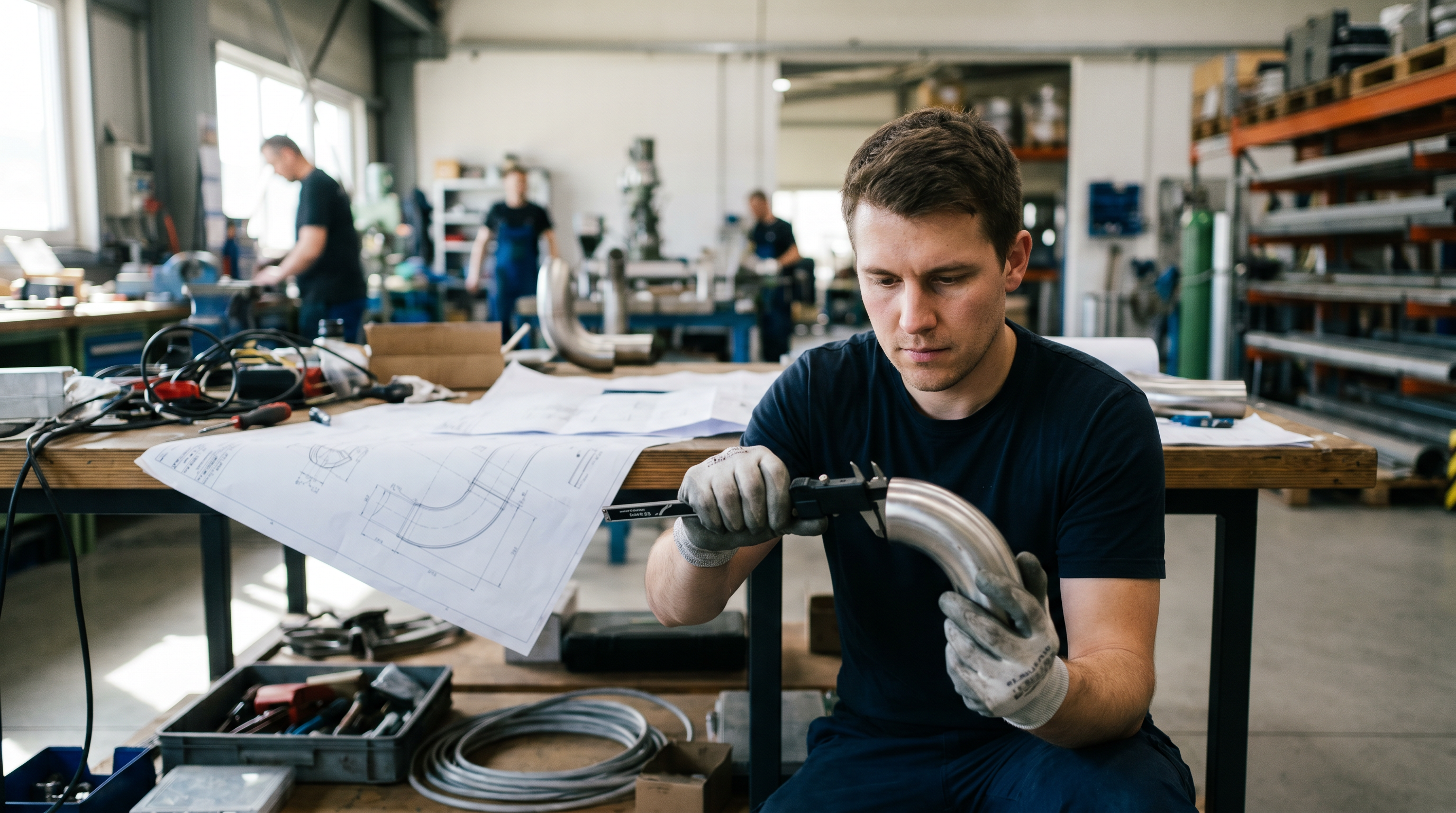
Dimensional Inspection: Confirm center-to-center distance, wall thickness at the intrados and extrados, and ovality against ASME B16.9 tolerances. Even minor deviations in a 3D bend radius create misalignment at weld joints and unpredictable stress concentrations under pressure.
-
Visual and Surface Inspection: Check for seams, laps, cracks, or tool marks — particularly at the bend crown, where forming stresses are highest. Surface defects at this location are not cosmetic; they are fatigue initiation sites.
-
Hardness Testing: Critical for exotic alloys after cold-forming, and worth performing on carbon steel fittings that will operate in hydrogen-rich or sour service environments where hardness limits are specified by NACE MR0175.
-
PMI (Positive Material Identification): Mandatory for stainless and alloy components in any high-stakes application. XRF-based PMI takes minutes per fitting and eliminates the risk of a mismarked or mixed-grade component reaching a critical weld joint. This step is especially important when stainless steel and carbon steel 3D pipe bends are procured from the same supplier on the same order, since mismarked fittings from mixed batches are a documented source of field failures.
Implementing a rigorous compliance checklist across these five checkpoints reduces procurement errors, supports smoother project execution, and eliminates the costly rework that follows when a non-conforming fitting is discovered only after it has been installed.
Key Takeaways
Stainless steel and carbon steel each serve distinct roles in 180° return bend applications, and choosing between them requires honest evaluation of operating environment, pressure class, and lifecycle cost — not just upfront material price. Stainless steel delivers measurable advantages in corrosion resistance and tensile strength, particularly when a short radius 180-degree bend concentrates stress through the fitting and leaves less geometric margin for error. Carbon steel remains the cost-effective default for dry, low-corrosion service where those properties are not required.
The 3D bend radius distributes stress more gradually than tighter configurations, making the long radius 180 return bend the preferred specification for high-cycle and high-pressure systems regardless of material. ASME B16.9 return bends govern dimensional tolerances and pressure ratings across both grades, ensuring interchangeability and compliance are preserved throughout the system.
When the application involves seawater immersion, halogen-rich process streams, or sustained temperatures above 1,000°F, neither carbon steel nor standard stainless steel is adequate — and exotic alloy return bends in Monel, Inconel, or related nickel-based grades become the correct specification, not an upgrade. Recognizing that threshold is as important as the stainless steel vs. carbon steel decision itself.
Dimensional compliance, quality documentation, and material traceability are non-negotiable at every tier of this selection process. A fitting that falls outside ASME B16.9 tolerances introduces liability into every downstream weld joint, regardless of how well the base material was specified.
Conclusion: Making the Strategic Material Choice
Choosing the right 180° return bend is never a single decision — it is a convergence of cost constraints, environmental demands, geometric requirements, and ASME compliance obligations. Every variable in this comparison carries real consequences: from the chromium oxide layer that allows stainless steel to resist corrosion without surface coatings, to the procurement verification steps that ensure certified material actually reaches your job site.
Geometry and material selection are inseparable in practice. A short radius 180 degree bend concentrates stress more aggressively through the fitting than a long radius configuration, which means the mechanical properties of your chosen alloy become a more immediate constraint rather than a theoretical ceiling. When space limitations force a short radius 180 degree bend into the design, stainless steel's higher tensile and yield strength provide a measurable safety margin that standard carbon steel cannot always match. Where the layout permits, a long radius 180 return bend distributes stress more gradually and gives whichever material you specify the best possible chance to perform within its mechanical limits across the full service life of the system.
Carbon steel remains the defensible choice for dry, low-corrosion environments where budget pressure is real and service conditions are predictable. Stainless steel justifies its cost premium wherever corrosion resistance, hygienic compliance, or elevated operating temperatures are part of the specification. When the application pushes past what either material can reliably sustain — seawater immersion, halogen-rich process streams, sustained temperatures above 1,000°F — exotic alloys become the only credible path forward.
ASME B16.9 ties these decisions together. Dimensional compliance is the framework that ensures your material choice, your radius selection, and your weld joints all function as a coherent system rather than a collection of individually specified components. Every return bend that leaves a certified manufacturer to a verified standard reduces the compounding risk that comes from getting any one of those variables wrong.
Make the material decision early, validate it against the full service envelope, and hold every fitting to the dimensional standard. That is the framework this guide has built toward — and the one that holds up under engineering scrutiny.
The ASME B16.9 standard governs the manufacturing of factory-made wrought buttwelding fittings, including 180° return bends, in sizes NPS 1/2 through NPS 48.
Source: ASME (American Society of Mechanical Engineers)
Stainless steel return
180-degree long radius elbows are also called 180-degree return bends, typically used to change flow direction in heating coils or heat exchangers.
Source: Creative Piping
bends (Grades 304/316) offer a tensile strength of 515–860 MPa, while standard carbon steel typically ranges from 400–600 MPa.
Source: Tebunus B.V.
Last updated: May 4, 2026