Mastering 180° Return Bends – A Comprehensive Guide | Stainless India
Master 180° return bends with our engineering guide. Compare carbon, stainless, and exotic alloys for short and long radius piping systems meeting ASME standards.
180° Return Bends sit at the intersection of fluid dynamics, material science, and precision manufacturing — yet they rarely receive the engineering attention they deserve. In most piping system designs, the straight runs and pressure vessels command the specification effort, while the components responsible for reversing flow direction get treated as catalog afterthoughts. That's a costly assumption.
This guide challenges that approach. Whether you're designing a multi-pass heat exchanger, routing a boiler header through a congested equipment bay, or specifying reactor coil components for a corrosive chemical service, the return bend you select carries consequences that extend well beyond its physical footprint. Dimensional tolerances, material properties, bend geometry, and supplier compliance all converge in a single fitting — and getting any one of those variables wrong can compromise the integrity of the entire system.
What follows is a structured engineering walkthrough covering the decisions that matter most: how carbon steel and stainless steel compare under real operating conditions, when exotic alloys like Monel and Inconel become the only defensible choice, how long-radius and short-radius geometries affect hydraulic performance, and what procurement teams need to verify before a fitting ever reaches the job site. Sustainability considerations and ASME B16.9 compliance requirements are woven throughout, because modern engineering practice demands that performance, safety, and environmental accountability be evaluated together — not in isolation.
If you've been specifying return bends by habit rather than by analysis, this guide is the reset that process deserves.
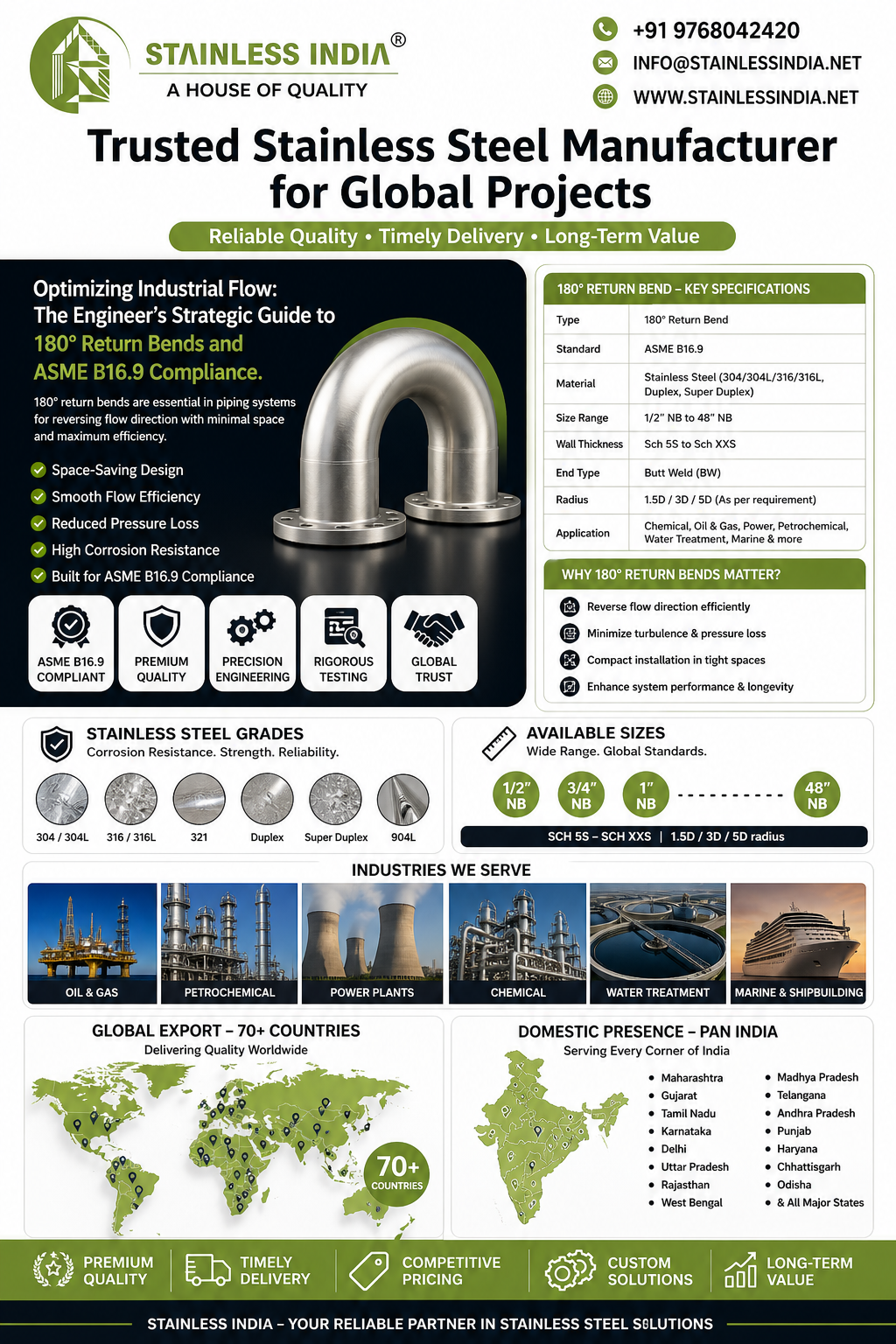
The Critical Role of 180° Return Bends in Modern Piping
When a process pipeline needs to reverse flow direction within a confined footprint — think heat exchangers, boiler headers, or chemical reactor coils — 180° Return Bends are the engineered solution that makes it possible. These fittings aren't simply curved pipe segments. They're precision-manufactured components that carry enormous responsibility: maintaining flow integrity, resisting pressure surges, and fitting seamlessly into systems where misalignment can cascade into catastrophic failure.
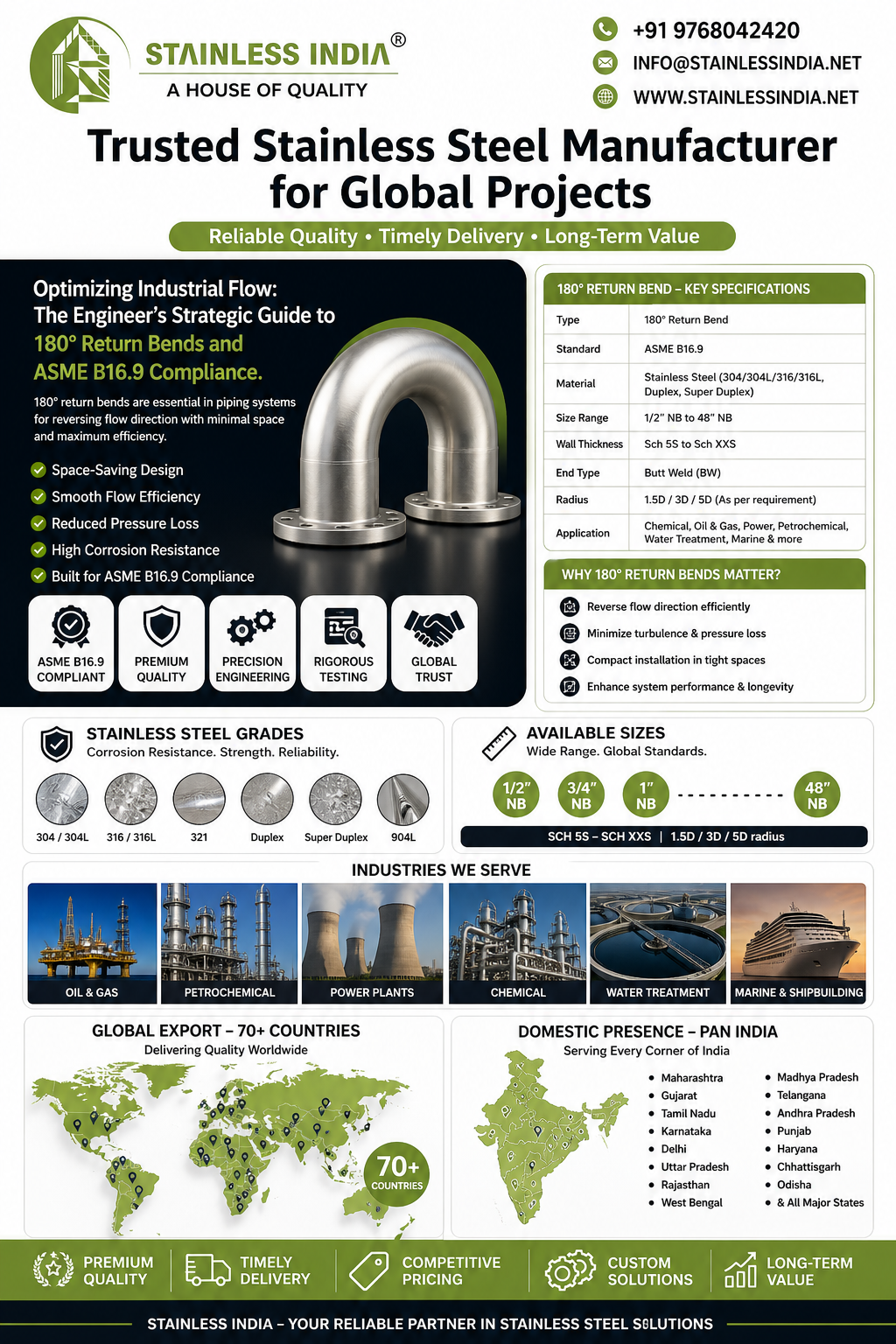
Key Standard to Know: The ASME B16.9 standard governs factory-made wrought buttwelding fittings — including 180° return bends — across a size range of NPS 1/2 through NPS 48 , establishing the dimensional, tolerance, and material marking requirements that engineers depend on globally.
That governing framework exists for good reason. In high-pressure piping systems, dimensional tolerances aren't a preference — they're a hard constraint. A wall thickness deviation or a centerline-to-end dimension that falls outside specification can compromise weld joint alignment, introduce stress concentrations, and ultimately undermine the mechanical integrity of the entire assembly. In practice, specifying a fitting that meets ASME B16.9 is the baseline, not the ceiling.
Understanding what a return bend must do is only half the engineering challenge. The other half is choosing the right material for the application. Carbon steel and stainless steel each bring a fundamentally different set of mechanical and corrosion-resistance properties to the table — and that difference becomes especially pronounced in the geometry of a 3D pipe bend radius.
Metallurgical Showdown: Carbon Steel vs. Stainless Steel 3D Bends
Choosing between carbon steel and stainless steel for a return bend isn't just a budget decision — it's an engineering decision with real performance consequences. Now that we've established why 180° return bends matter in system design, it's worth examining what happens at the material level when these components face real operating conditions.
Strength by the Numbers
The mechanical differences between these two material families are significant. According to Tebunus B.V., stainless steel return bends in Grades 304 and 316 deliver a tensile strength of 515–860 MPa , while standard carbon steel typically ranges from 400–600 MPa. That's a meaningful gap, especially in high-pressure or thermally cyclic environments.
Yield strength tells a similar story. Stainless alloys hold the line at 205–450 MPa before deformation , compared to 250–400 MPa for carbon steel. In practice, this means stainless components can absorb greater stress without permanent shape change — a critical factor in systems where pressure surges or thermal expansion are routine.
|
Property |
Carbon Steel |
Stainless Steel (304/316) |
|---|---|---|
|
Tensile Strength |
400–600 MPa |
515–860 MPa |
|
Yield Strength |
250–400 MPa |
205–450 MPa |
|
Corrosion Resistance |
Low–Moderate |
High |
|
Relative Material Cost |
Lower |
Higher |
How the 3D Bend Radius Factors In
The 3D pipe bend radius — where the centerline radius equals three times the nominal pipe diameter — is the industry standard for return bends manufactured to ASME B16.9 return bends specifications. Material choice directly affects how well a fitting holds its geometry through the bending process. Stainless steel's higher work-hardening rate can make forming more demanding, but it also results in a denser, more dimensionally stable finished bend.
Carbon steel, being more malleable, is easier and cheaper to form. However, it demands protective coatings or linings in corrosive environments, adding lifecycle cost that can offset the initial savings.
Which Material Actually Wins?
The honest answer: neither is universally superior. Carbon steel makes sense for dry, low-corrosion, high-throughput industrial systems where budget discipline matters. Stainless becomes the logical choice when fluid chemistry, temperature cycling, or regulatory requirements demand it.
For applications where even Grade 316 stainless begins to fall short — think aggressive chlorides, extreme heat, or concentrated acids — the selection process pushes into a different category of materials entirely.
When to Specify Exotic Alloys: Monel, Inconel, and Beyond
Having established how carbon steel and stainless steel perform under typical operating conditions, it's worth asking a harder question: what happens when "typical" doesn't apply? Some industrial environments push well past the limits of standard alloys — and that's exactly where exotic materials earn their place in the spec sheet.
Corrosion Resistance: Where Stainless Steel Reaches Its Limits
Stainless steel handles a broad range of corrosive media, but it's not invincible. Chloride-rich environments — seawater systems, offshore platforms, saltwater cooling loops — can trigger pitting corrosion and stress corrosion cracking in even high-grade austenitic stainless. When discussing the stainless steel vs carbon steel 3D pipe bends decision, most engineers already understand carbon steel's vulnerability to moisture. What's less obvious is where stainless also falls short.
This is where Monel (typically Monel 400) steps in. Its nickel-copper composition delivers exceptional resistance to seawater, hydrofluoric acid, and alkalis — making it a preferred choice in marine piping systems and aggressive chemical processing loops. For return bends operating in those environments, Monel consistently outperforms standard stainless grades.
-
Monel 400: Marine heat exchangers, seawater handling, hydrofluoric acid service
-
Inconel 625: High-pressure chemical reactors, offshore subsea applications
-
Hastelloy C-276: Oxidizing and reducing acid environments, pharmaceutical processing
Thermal Stability: Performing Beyond the Stainless Ceiling
As Darren Eyre, Technical Specialist at Lee Spring, notes: "The reliability of the finished product in its application hinges on the correct material selection… Stainless steel is tough but does not offer the properties required to withstand extreme heat above its limit."
Inconel alloys maintain mechanical strength at temperatures exceeding 1,800°F — far beyond stainless steel's practical service range. In fired heater headers or superheater tube returns, that difference is critical.
Cost-Benefit: Justifying the Premium
Exotic alloys carry significant price premiums over standard materials. However, one failed return bend in a hazardous service line can cost far more than the material upgrade ever would. The calculus favors exotic alloys when:
-
Replacement access is limited (buried or submerged systems)
-
Downtime costs are severe (continuous chemical or refining processes)
-
Safety risk is elevated (toxic or high-pressure media)
With materials selected for the environment, the next engineering variable to optimize is bend geometry — and radius choice matters more than most engineers initially expect.
Geometry Matters: Long Radius (LR) vs. Short Radius (SR) Bends
With material selection addressed — from carbon and stainless steel to exotic alloy return bends — the next engineering variable that significantly shapes system performance is bend geometry. Specifically, the difference between Long Radius (LR) and Short Radius (SR) configurations determines how fluid moves through the bend, and getting this wrong can mean costly pressure drops or premature component fatigue.
As noted by Creative Piping , 180-degree return bends are the standard solution for reversing flow direction in heating coils and heat exchangers — and the radius you specify directly affects how efficiently that reversal happens.
Defining the Geometry
-
Long Radius (LR): Center-to-face dimension equals 1.5 times the nominal pipe diameter (1.5D) . The wider arc creates a gradual flow transition.
-
Short Radius (SR): Center-to-face dimension equals 1.0 times the nominal pipe diameter (1D) . The tighter arc compresses the same turn into less physical space.
A common standard for LR bends is the 4-inch carbon steel configuration, which follows ASME B16.9 dimensional tolerances and is widely stocked across industrial supply chains.
Choosing Between LR and SR: Application Scenarios
|
Long Radius (LR) — Best For |
Short Radius (SR) — Best For |
|---|---|
|
Low-pressure drop requirements |
Space-constrained installations |
|
High-flow, continuous-process systems |
Lower-velocity or intermittent flow |
|
Slurry or viscous fluid applications |
Compact heat exchanger bundles |
|
Systems where turbulence must be minimized |
Cost-sensitive, non-critical loops |
The practical rule: a tighter radius means higher flow resistance — typically a measurable pressure drop penalty that compounds across multiple bends in a long coil run.
On the other hand, SR bends offer real spatial advantages where equipment footprint is tightly restricted. The engineering decision ultimately balances hydraulic efficiency against installation constraints. That balance also carries environmental implications worth examining — particularly when evaluating how the production of these materials impacts a project's broader sustainability targets.
The Sustainability Factor: Energy Efficiency in Production
Material selection doesn't just affect performance and cost — it increasingly shapes a project's environmental footprint. As procurement teams face mounting pressure to meet corporate sustainability targets, the energy profile of each component in a pipeline system deserves serious attention.
The numbers are striking: stainless steel production is approximately 35% more energy-efficient than carbon steel and can reduce CO2 emissions by more than 47% per ton when manufactured using short-process electric furnace technology .
This shift matters at scale. Traditional carbon steel production relies heavily on blast furnace methods that consume large volumes of coking coal. By contrast, electric arc furnace (EAF) short-process technology recycles scrap metal, dramatically cutting energy consumption and direct emissions. For procurement engineers specifying high-volume fittings — think a short radius 180 degree bend used across dozens of heat exchanger passes — the cumulative emission savings across a full bill of materials can be substantial.
The connection between material science and sustainability strategy is becoming a procurement differentiator. In practice, large industrial operators in the energy, chemical, and food processing sectors are beginning to require environmental product declarations (EPDs) and lifecycle assessment data alongside traditional material certifications. Choosing stainless steel fittings manufactured via short-process methods doesn't just reduce a plant's Scope 3 emissions — it often aligns with ESG reporting frameworks that investors and regulators now scrutinize closely.
Of course, sustainability goals must be balanced against application requirements and budget constraints. Understanding which material was produced how becomes part of the procurement conversation — which brings quality documentation and supplier verification into sharp focus.
Procurement and Quality Control: Ensuring ASME Compliance
With sustainability and energy efficiency now part of the broader engineering conversation, the procurement process becomes the final checkpoint where good material decisions either get validated — or undermined. Sourcing the right 180° return bend means combining smart specification practices with rigorous inspection protocols.
Reading the Part Numbering System
Part numbers for return bends aren't arbitrary strings of characters. Each segment communicates critical engineering data: nominal pipe size, schedule, material grade, bend type (LR or SR), and end finish. For a long radius 180 return bend , the designation typically encodes the center-to-end dimension multiplied by the nominal diameter, along with the applicable ASME standard (most commonly ASME B16.9 for factory-made wrought fittings). Understanding this system upfront prevents costly misorders and simplifies cross-referencing with certified mill test reports (CMTRs).
Inspection Methods That Matter
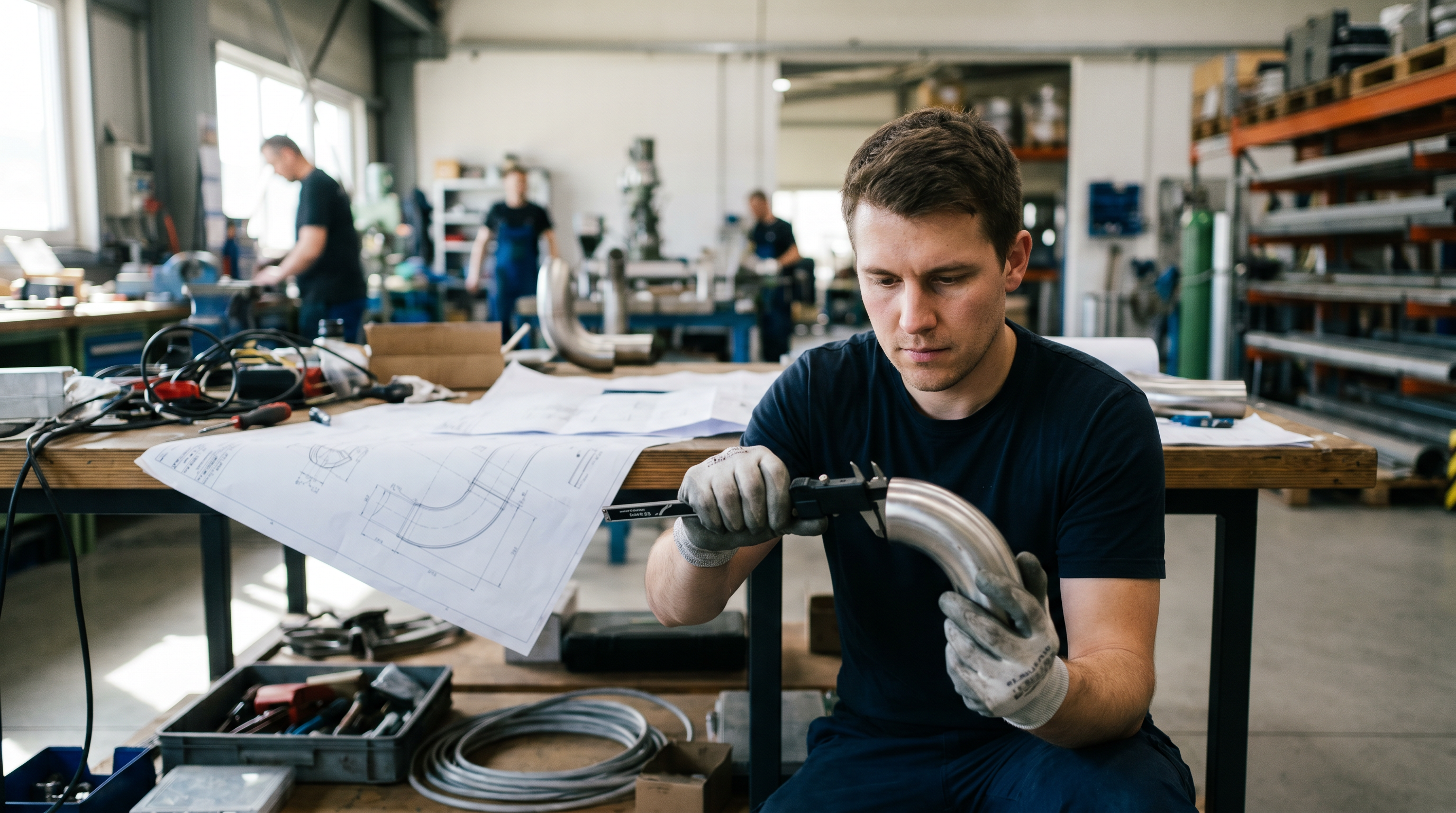
"Inspection methods for 180-degree bends must ensure strict dimensional tolerances for center-to-center distances to permit easy welding and alignment." — Mesta Inc / Ganpat Industrial Corporation
That principle should anchor every receiving inspection. Here's a practical checklist for procurement officers:
-
Dimensional verification: Confirm center-to-center and center-to-end distances against ASME B16.9 tolerances using calibrated gauges
-
Wall thickness measurement: Ultrasonic testing at the bend intrados, where thinning is most pronounced
-
Material certification review: Match heat numbers on CMTRs to physical markings on the fitting
-
Visual and surface inspection: Check for seams, cracks, or surface irregularities — especially critical in stainless and exotic alloy components
-
Hardness testing: Particularly relevant for alloys that may have been incorrectly heat-treated post-forming
Navigating Global Sourcing
India's manufacturing hubs — particularly Mumbai — supply a significant volume of ASME-compliant fittings globally. However, quality varies considerably across vendors. When sourcing through platforms like IndiaMART, request third-party inspection reports from recognized bodies (SGS, Bureau Veritas) before finalizing purchase orders. Verify that manufacturers hold current PED or ASME certifications, not just self-declarations.
Getting procurement right creates the foundation for every strategic material choice — and those trade-offs are worth examining more closely as we draw conclusions.
Conclusion: Making the Strategic Material Choice
Selecting the right material for 180° return bends is never a single-variable decision. As this industrial pipe fittings guide has outlined, every choice balances upfront cost , operating environment , and strict ASME compliance requirements — and getting that balance wrong can mean catastrophic failures, costly downtime, or regulatory exposure.
The right material isn't always the cheapest — it's the one that performs reliably under your exact operating conditions for the longest possible service life.
For high-heat environments, aggressive chemical exposure, or offshore and pharmaceutical applications, prioritizing stainless steel or exotic alloys like Inconel, Duplex, or Hastelloy is the strategically sound choice. The higher acquisition cost is consistently offset by reduced maintenance cycles, longer service intervals, and fewer unplanned shutdowns. Carbon steel remains a strong performer in moderate-pressure, low-corrosion settings where budget constraints are real and operating conditions are well-understood.
Final Decision Checklist:
-
Operating temperature above 750°F? → Evaluate stainless or nickel alloys
-
Exposure to chlorides, acids, or caustic media? → Exotic alloys warrant serious consideration
-
Budget-constrained, moderate-service application? → Carbon steel with appropriate coatings may suffice
-
ASME Section IX and B31.3 compliance required? → Document material certifications at procurement
No checklist, however thorough, replaces specialized expertise. Custom 3D pipe bend geometries — particularly in exotic alloys — introduce fabrication variables that demand a metallurgical specialist's input. Before finalizing specifications, consulting with a qualified engineer ensures your material selection holds up where it matters most: in the field.
Beyond the U-Turn: A Strategic Engineering Guide to 180° Return Bends in High-Stakes Industrial Piping
Every material decision discussed throughout this guide converges at a single point: operational reliability under pressure. Whether you're specifying carbon steel for a refinery loop, stainless for a pharmaceutical system, or an exotic alloy for a cryogenic application, the 180° return bend is never just a fitting — it's a critical performance node where flow dynamics, thermal stress, and material integrity interact simultaneously.
What typically happens in high-stakes piping systems is that failure isn't sudden. It's incremental — microscopic corrosion, fatigue cycling, and pressure fluctuation that compound over months or years. Selecting the wrong material at this junction point can compromise an entire system long before any visible warning sign appears.
Acknowledging that tradeoffs exist is essential: even premium alloys have limitations in certain chemical environments, and no single specification fits every scenario. Matching material properties to actual service conditions — not just assumed ones — remains the most practical engineering discipline available.
This reality becomes especially critical in heat exchanger applications, where thermal cycling and aggressive media push return bends to their absolute design limits.
Solving Heat Exchanger Failure: Choosing the Right 180° Bend for Extreme Environments
Heat exchangers represent one of the most demanding environments a 180° return bend will ever face. Thermal cycling, aggressive process fluids, high pressures, and tight tube bundle geometries create a convergence of failure mechanisms that punishes poor material choices quickly and expensively.
Thermal fatigue is the dominant failure mode in most heat exchanger applications. Repeated expansion and contraction cycles stress the bend's extrados — the outer radius — disproportionately. In practice, tighter-radius bends amplify this stress concentration, making radius selection as critical as material selection.
Fluid compatibility is equally unforgiving. Cooling water circuits introduce chloride-induced stress corrosion cracking risks, while process-side fluids may carry sulfur compounds, acids, or abrasive particulates. No single alloy solves every problem simultaneously — a material optimized for corrosion resistance may sacrifice fatigue strength under sustained vibration loads.
Understanding how carbon steel, stainless steel, and exotic alloys each respond to these combined stressors requires a direct, side-by-side comparison — which the next section addresses in detail.
180° Return Bends: A Comparative Guide to Carbon, Stainless, and Exotic Alloys
With heat exchanger performance front of mind, the material selection question becomes impossible to ignore. Choosing the wrong alloy for a 180° return bend isn't just a procurement mistake — it's a future failure waiting to happen.
Material selection ultimately defines the ceiling of your system's reliability. Each alloy family brings a distinct set of trade-offs across temperature resistance, corrosion behavior, pressure rating, and cost.
Here's how the major categories compare:
-
Carbon steel — Cost-effective and widely available; ideal for moderate temperatures and non-corrosive service, but vulnerable to oxidation and acidic media
-
Stainless steel (304/316) — Strong corrosion resistance and good mechanical properties; the workhorse for chemical processing and food-grade applications
-
Duplex stainless — Superior strength and chloride resistance; well-suited for offshore and marine environments
-
Exotic alloys (Inconel, Hastelloy, Monel) — Engineered for extreme heat, pressure, and aggressive chemistry where standard grades simply can't perform
However, exotic alloys carry significant cost premiums, so their use should be justified by documented service conditions — not speculative risk aversion.
Understanding why each material behaves differently under stress comes down to its underlying geometry and metallurgical makeup — which is exactly where radius, schedule, and grain structure become critical variables.
The Anatomy of a 180° Return Bend: Radius, Schedule, and Metallurgy Explained
Understanding why a particular bend succeeds or fails starts with three fundamental variables: bend radius , schedule (wall thickness) , and metallurgical composition . These aren't independent choices — they interact in ways that define the component's real-world performance ceiling.
Bend radius is typically expressed as a multiple of nominal pipe diameter. A short-radius return bend (1D) generates tighter directional change with a smaller footprint, while a long-radius bend (1.5D) distributes stress more gradually, reducing turbulence and erosion risk under high-velocity flow. In practice, long-radius configurations dominate heat exchanger and process piping applications precisely for that reason.
Schedule , or wall thickness, determines pressure containment capacity. Heavier schedules (Sch 80, Sch 160) handle elevated pressures but add weight and cost — a tradeoff engineers must balance deliberately.
Metallurgy ties everything together. As covered in previous sections, carbon steel, stainless, and exotic alloys each bring distinct thermal and corrosion performance profiles that must align with both radius geometry and schedule selection.
Together, these three parameters form the engineering foundation that every industry — from offshore drilling to food processing — builds on differently.
From Oil Rigs to Food Plants: How Industry Needs Dictate 180° Bend Selection
No single 180° return bend fits every application, and nowhere is that reality more apparent than when comparing the demands of upstream oil and gas with food-grade processing environments. The operating variables — pressure ratings, sanitary requirements, temperature cycles, and regulatory compliance — pull in completely different directions depending on the industry.
In offshore and subsea applications, high-schedule carbon steel bends handle extreme pressures and mechanical stress, where wall integrity is the dominant concern. By contrast, food and beverage processing facilities prioritize smooth internal bore surfaces and full traceability certifications to prevent bacterial harborage and meet FDA standards — conditions where 316L stainless steel with electropolished interiors is essentially non-negotiable.
The industry context doesn't just influence material selection — it defines it entirely.
Power generation facilities lean on chromium-moly grades for elevated-temperature steam loops, while chemical processing plants must balance corrosion resistance against cost at every junction. What remains consistent across all these sectors is the underlying engineering logic: match the alloy and schedule to the actual service environment, not the most available option.
When those environments push beyond the capabilities of even premium stainless grades, that's precisely where Inconel, Monel, and Hastelloy enter the conversation.
Beyond Steel: When to Upgrade to Inconel, Monel, and Hastelloy Return Bends
Choosing the right alloy for a 180° return bend isn't just a materials science exercise — it's a strategic decision that directly affects system uptime, maintenance costs, and long-term safety.
The central principle is straightforward: carbon and stainless steels handle the majority of industrial piping applications, but when temperatures exceed 1,000°F, chloride stress corrosion becomes a factor, or aggressive acids are present, exotic alloys earn their premium price tag.
Key upgrade triggers include:
-
Inconel 625/825 — high-temperature oxidation resistance in fired heaters and exhaust systems
-
Monel 400 — seawater and hydrofluoric acid service where stainless fails rapidly
-
Hastelloy C-276 — mixed acid environments and aggressive chemical processing loops
Selecting the wrong alloy in a demanding return bend application can compress a 20-year asset life into fewer than 18 months. That's a cost no engineering budget absorbs easily.
Ultimately, every concept covered in this guide — radius geometry, schedule selection, metallurgy, and industry-specific standards — feeds into one decision: specifying a bend that performs reliably under your exact operating conditions. Review your system parameters against the frameworks outlined here, consult your materials engineer, and treat alloy selection as a front-end investment, not an afterthought.
The ASME B16.9 standard governs the manufacturing of factory-made wrought buttwelding fittings, including 180° return bends, in sizes NPS 1/2 through NPS 48.
Source: ASME (American Society of Mechanical Engineers)
Stainless steel return bends (Grades 304/316) offer a tensile strength of 515–860 MPa, while standard carbon steel typically ranges from 400–600 MPa.
Source: Tebunus B.V.
Yield strength for stainless alloys ranges from 205–450 MPa, compared to 250–400 MPa for carbon steel, indicating higher load capacity before deformation.
Source: Tebunus B.V.
180-degree long radius elbows are also called 180-degree return bends, typically used to change flow direction in heating coils or heat exchangers.
Source: Creative Piping
Stainless steel production is approximately 35% more energy-efficient than carbon steel and can reduce CO2 emissions by more than 47% per ton using short-process technology.
Source: Tubing China
Inspection methods for 180-degree bends must ensure strict dimensional tolerances for center-to-center distances to permit easy welding and alignment.
Source: Mesta Inc / Ganpat Ind